For a lot of people, TCM means one thing: a very bitter bowl of medicine.
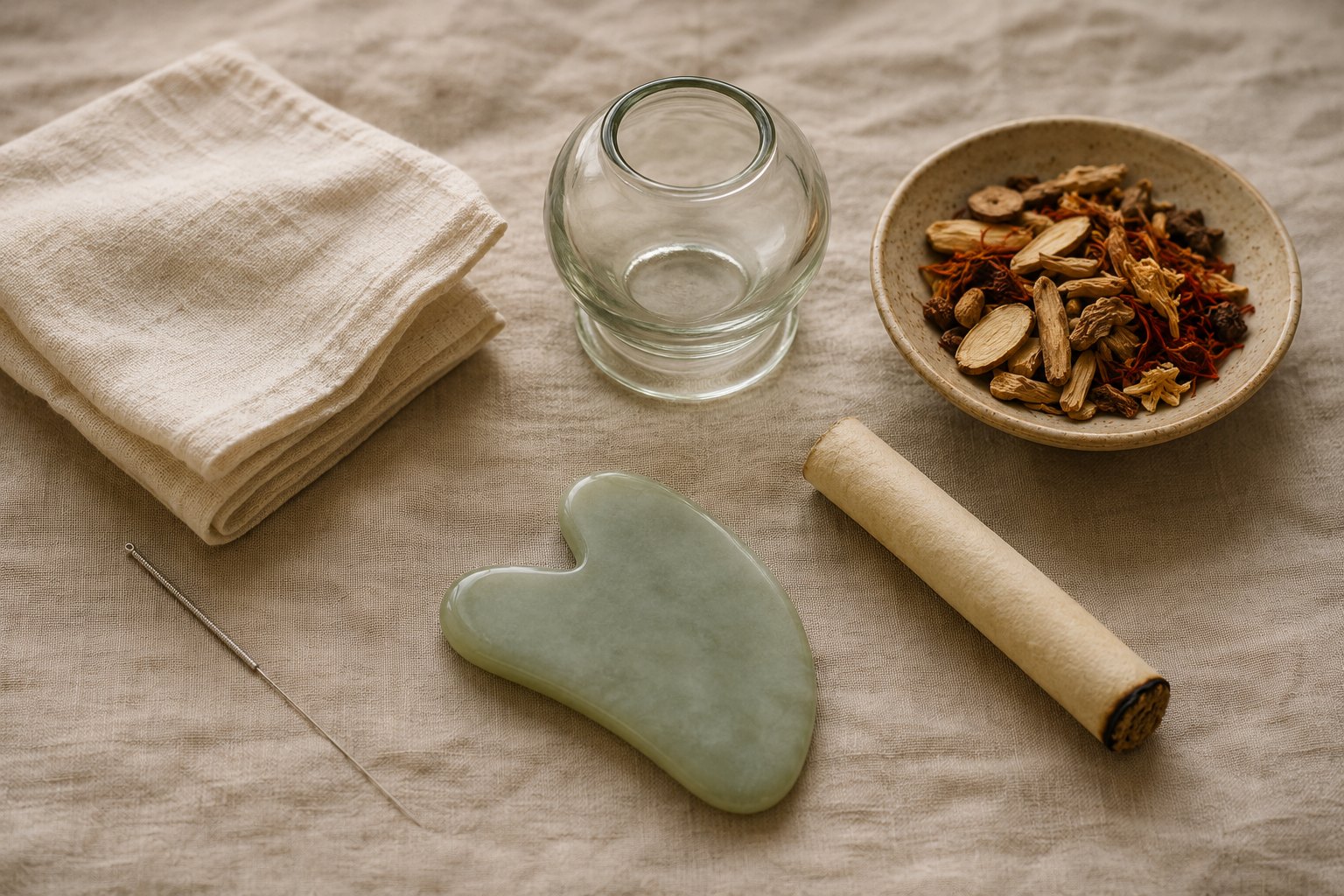
Herbal medicine is part of it, but only part. Walk into a TCM clinic and you might see fine needles, glass cups, moxa sticks, a smooth scraping tool — or none of that at all, because the practitioner spent half an hour asking you questions.
This article covers six common TCM treatments in one place: what each one is, roughly what the process involves, and how a practitioner decides which to use.
By the end you should have a complete outline of what actually happens in a TCM clinic.
First, one idea that makes the rest easier
There is a concept worth having before the list.
A practitioner does not begin by choosing a treatment. They begin with pattern differentiation (辨证) — gathering information through looking, listening, asking and pulse taking, and forming an assessment of the overall state. The treatment comes after that assessment.
So "is acupuncture better, or herbs?" is, within the TCM framework, the question the wrong way round. The assessment comes first; the method follows.
1. Acupuncture
What it is: very fine needles inserted at specific points on the body.
An acupuncture needle and a hypodermic needle are different objects — a hypodermic is hollow, an acupuncture needle is solid and considerably finer.
The process: the practitioner selects points based on their assessment, and needles are usually retained for 15 to 30 minutes, and the retention time is spent lying still. Points are not necessarily where the discomfort is — point selection follows meridian theory, and using points on the hands and feet for concerns elsewhere is common practice.
Worth knowing: standard clinical practice is single-use sterile needles, discarded after use. If you feel sharp pain or anything uncomfortable during a session, say so — the practitioner can adjust or remove the needle.
→ In detail: Does Acupuncture Hurt? 5 Things to Know Before Your First Session
2. Cupping
What it is: creating negative pressure at the skin's surface so a cup draws onto the body.
Two forms are common: fire cupping, where a flame creates the vacuum inside the cup, and vacuum cupping, where a hand pump draws the air out. The principle is the same; what differs is how the vacuum is made.
The process: cups usually stay in place for a few minutes up to around fifteen. There is also a moving technique where the cup is slid across oiled skin.
Worth knowing: cupping leaves circular marks; how long they take to fade varies from person to person. If they persist, or anything seems wrong, contact your practitioner. There is a widely repeated claim that darker marks mean more toxins — this has no basis in TCM theory. Mark colour is affected by many things and is not a readout of your health.
3. Gua sha
What it is: stroking the skin with a smooth-edged tool — often horn, bian stone or ceramic — after applying a lubricant.
Worth separating: the small facial tool you have seen on social media and clinical gua sha share a name, but the technique and the intent are not the same.
The process: the practitioner applies oil or lotion, then strokes along a set direction. Red or purplish spotting may appear on the skin; TCM calls this 痧 (sha).
Worth knowing: as with cupping marks, how much sha appears is not a score card. Scraping until the skin breaks, or until it genuinely hurts, is not correct technique.
4. Moxibustion
What it is: burning mugwort, prepared as a stick or cone, to apply warmth at specific points on the body.
The process: several forms exist — holding a moxa stick at a distance above the skin, placing moxa on a slice of ginger or a bed of salt, or using a temperature-controlled device. The burning moxa produces warmth, along with the smell and smoke of burning mugwort.
Worth knowing: moxibustion involves an open flame and real heat, and burns are a genuine risk — one reason moxibustion belongs in trained hands. Clinics generally manage ventilation and safety. If the heat feels like too much, say so immediately rather than enduring it.
5. Tuina
What it is: TCM manual therapy — the practitioner applies pressure and movement by hand.
Tuina is not the same as general massage. It is a clinical technique carried out within a TCM assessment framework, by a trained registered practitioner. The training, the purpose and the regulation all differ.
The process: area and technique follow the assessment, and pressure is adjusted to the situation. If something hurts, say so — tuina is not a "more pain, more benefit" proposition.
6. Herbal medicine
What it is: a formula composed of several herbs, prescribed according to the assessment.
This part matters: a herbal prescription is specific to the person. Two people who both come in about poor sleep may be assessed differently, and their formulas will differ accordingly. Which is why medicine that suited someone else is not something to take yourself.
Forms: common in Malaysia are traditional raw herbs you decoct yourself, granules or concentrated powders that dissolve in hot water, and prepared forms such as pills and pastes. Which suits you is decided with your routine in mind.
Worth knowing: if you take Western medication, tell your TCM practitioner, and never stop prescribed medication on your own. Equally, let your doctor know you are taking Chinese herbs.
→ In detail: Can You Take Chinese Herbs With Western Medication?
So how does a practitioner choose?
This is the practical question on this page.
Briefly: the assessment, plus practical reality.
- The assessment sets the direction — what it points to shapes what is used
- Location and nature narrow it — something needing hands-on work differs from something approached through longer-term adjustment
- Your circumstances count too — whether you can attend regularly, whether decocting herbs is realistic, whether needles worry you. All of that can and should be said out loud
Sometimes several are combined — acupuncture alongside herbs is common. Sometimes the practitioner concludes nothing needs prescribing and gives advice about routine instead. That is a legitimate outcome.
What is outside TCM's scope
This section matters as much as the ones above it.
Difficulty breathing, chest pain, any change in consciousness, injury, or heavy bleeding — call 999 now, or go to the nearest emergency department.
TCM deals with non-urgent health concerns. Anything requiring imaging, surgery or emergency care belongs to Western medicine. TCM is complementary care, not a replacement.
A responsible practitioner will tell you when something should go to a doctor first — being willing to draw that line is a mark of professionalism.
Common questions
Do I have to have acupuncture? Can I just take herbs? It is open to discussion. The practitioner will explain why they suggest a particular approach, and you can raise your own concerns.
Can these be combined? Yes — combining them is common in practice, arranged by the practitioner.
What can be done in an online consultation? None of the hands-on treatments — acupuncture, cupping, gua sha, moxibustion, tuina — can be done remotely. Online consultation covers history-taking, assessment and prescribing.
→ In detail: Online TCM Consultation in Malaysia — What It Can and Cannot Do
What happens on a first visit? A first visit is mostly questioning. The practitioner needs to form an assessment before deciding anything else.
In closing
TCM is not one treatment. It is a way of assessing, plus several methods that can be used together.
You do not need to decide in advance which one you want — that was always the practitioner's job. What you need to do is describe your situation clearly, and say what worries you.
👉 If you are unsure which of these treatments you should start understanding first, you are welcome to book an online consultation with HansMed, where a practitioner registered under the T&CM Act 2016 can assess it with you.
Sit with a licensed TCM practitioner from wherever you are.
HansMed Modern TCM
For general wellness education only — not medical advice. Consult a registered TCM practitioner for personal guidance.


