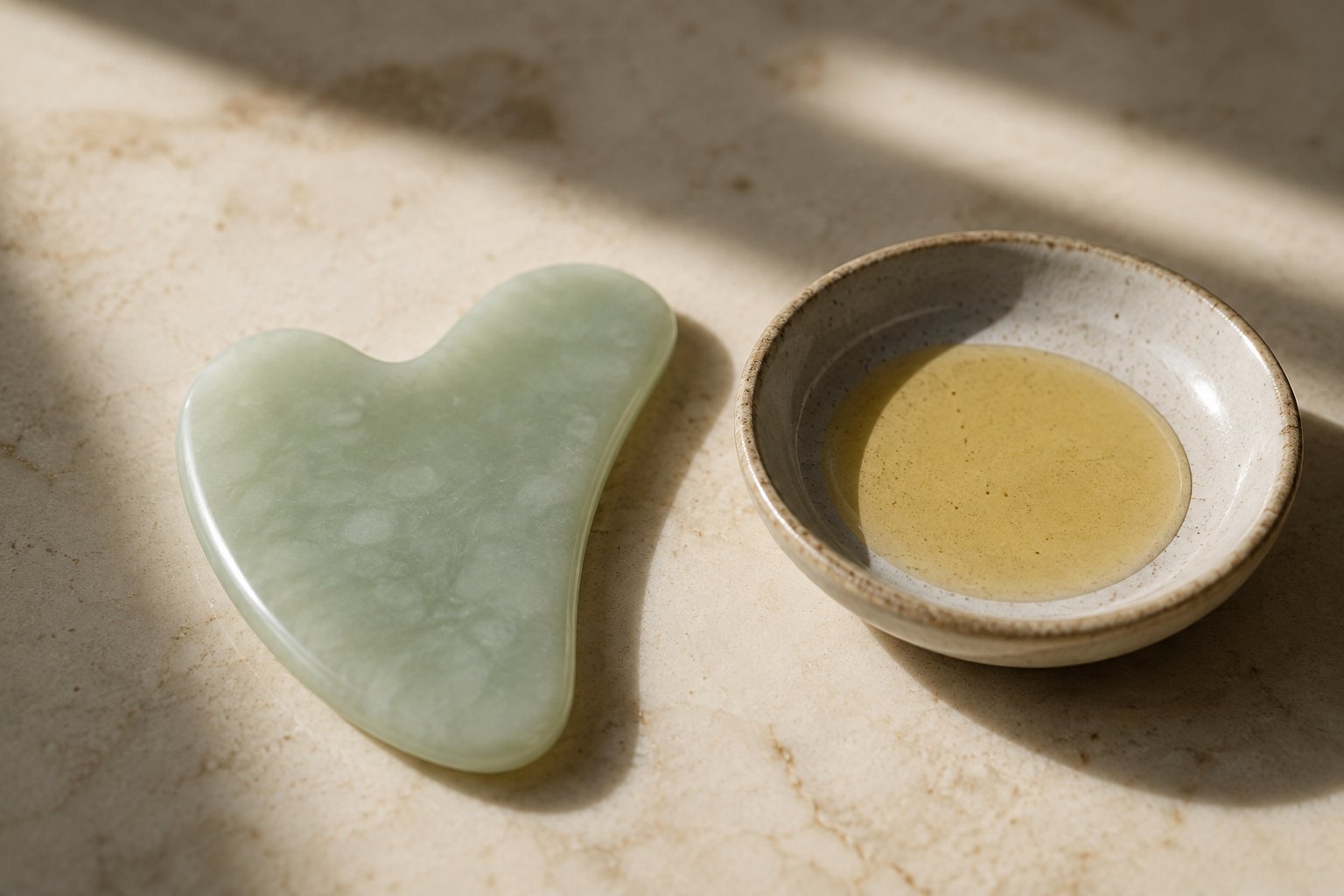
A question that comes up often is: "Is gua sha supposed to hurt more for better results?" and "Does more sha mean a bigger health problem?" These questions are common, but they also reflect a number of misunderstandings about gua sha. This article explains what gua sha is, what actually happens during a session, and what you should consider before receiving one.
What It Is
Gua sha is a traditional therapeutic technique within TCM. During a session, a practitioner uses a smooth-edged tool (commonly made from buffalo horn, ceramic or stainless steel) with a medium such as massage oil or herbal balm, and repeatedly scrapes the skin in specific directions. Gua sha belongs to the same family of TCM external therapies as cupping and acupuncture. It is not a treatment for any specific disease, nor is it a method of "detoxification."
In TCM theory, gua sha is understood as a way of "unblocking the meridians" (疏通经络) and "promoting the flow of qi and blood" (行气活血). It should be noted that meridians and qi are part of the theoretical framework of TCM, and are not the same as anatomical blood vessels or nerves.
The Process
In a TCM clinic that offers this service, the general process is as follows:
- During the consultation, the practitioner will ask about your health history, current medications and any ongoing conditions, to assess whether gua sha is suitable for you.
- If suitable, the practitioner will ask you to expose the area to be treated (commonly the back, neck, shoulders or limbs).
- The practitioner applies a medium to the skin, then uses the scraper at a specific angle and pressure to scrape the area repeatedly.
- During the process, red or dark red marks may appear on the skin surface. These marks are called sha (痧).
- After the session, the practitioner will explain how to care for the treated area.
This clinic currently operates through online consultations only, and in-person services have not yet been launched. The process described above reflects the common practice of TCM clinics in general, and does not specifically describe this clinic's on-site operations.
The physical action of the tool is straightforward — a scraper is moved repeatedly across the skin, and sha marks may appear on the surface. This is visible and verifiable. As for what this means in TCM theory, that belongs to the framework of meridians and qi, which is not the same as a modern physiological explanation.
What It Feels Like
The sensation during gua sha is often described as "warm," "tingly" or "slightly sore." Tolerance to scraping pressure varies from person to person. If you experience unbearable pain during the session, tell the practitioner immediately.
After the session, sha marks may appear on the treated area. The depth of colour varies from person to person. The time it takes for the marks to fade also varies — if they persist or do not improve, contact your practitioner.
Safety, Hygiene and What to Tell Your Practitioner
Gua sha is a relatively non-invasive therapy, but safety and hygiene still matter. In clinics that offer gua sha, disposable scrapers are commonly used, or reusable scrapers are cleaned and disinfected between sessions. If you have concerns about this, ask when booking your appointment.
During the consultation, be sure to tell your practitioner if you:
- Have any skin conditions (such as eczema, psoriasis or open wounds)
- Are taking any medication, including over-the-counter products or TCM proprietary medicines (do not stop any medication on your own — discuss it with your doctor first)
- Are pregnant
- Have a bleeding disorder or any blood-related condition
- Have a cardiac pacemaker
- Have a chronic condition such as diabetes, heart disease or hypertension
A note: this section is general information only. For conditions like these, follow your doctor's diagnosis and treatment, and seek medical attention when you need it.
Possible Reactions After the Session and When to Contact Your Practitioner
Sha marks appearing on the treated area are a common skin reaction after gua sha. The depth and amount of sha are influenced by several factors, including skin thickness, scraping time and pressure. They are not a measure of how serious your condition is, and cannot be used to judge the state of your body. The popular claim that "more sha means more toxins" lacks reliable evidence.
After a gua sha session:
- The treated area needs proper care. Avoid rubbing or scrubbing it vigorously.
- If blisters, broken skin or significant swelling develop, contact your practitioner.
- If you feel dizzy, nauseous or experience palpitations after the session, contact your practitioner.
When Gua Sha Is Not Suitable
Common precautions listed in TCM literature include: do not scrape over areas with broken skin, infection or inflammation; avoid the abdomen and lower back during pregnancy; and individuals who are frail or taking anticoagulant medication should be assessed by a registered TCM practitioner before receiving gua sha.
The following situations are not within the scope of gua sha. Call 999 or go to the nearest emergency department:
- Loss of consciousness or seizures
- Persistent high fever
- Severe injury or fracture
- Chest pain or difficulty breathing
A note: this section is general information only. For conditions like these, follow your doctor's diagnosis and treatment, and seek medical attention when you need it.
The 5 Things to Note (Recap)
- Tell your practitioner beforehand: skin conditions, chronic conditions, medications (especially anticoagulant medication), and pregnancy.
- Hygiene: check that scrapers are disposable, or cleaned and disinfected between sessions.
- Aftercare: care for the treated area properly and avoid rubbing it vigorously.
- When it is not suitable: areas with broken, infected or inflamed skin; see the situations listed above for the rest.
- When to get help: contact your practitioner if blisters, broken skin, significant swelling or ongoing discomfort develop; in an emergency, call 999 or go to the nearest emergency department.
Common Questions
Q: Is gua sha the same as the facial gua sha tools seen on social media?
A: The name is the same, but the usage and purpose differ. Gua sha in a clinical setting is a TCM external therapy performed by a registered TCM practitioner on specific body areas. Facial gua sha tools on social media are mostly home-use beauty tools. They are not the same thing.
Q: Does more sha mean better results?
A: No. The amount and depth of sha are influenced by skin thickness, scraping pressure and duration. It is not a scorecard for results. Scraping until the skin breaks or causes significant pain is not correct practice.
Q: Can gua sha help with weight loss?
A: Gua sha is not a weight-loss method. Weight management involves diet, physical activity and overall lifestyle habits. If you have weight-related goals, it is advisable to seek comprehensive advice from nutritional and medical professionals.
Q: Can I shower after gua sha?
A: The treated area needs proper care. Specific advice on showering depends on individual circumstances and the practitioner's instructions. Ask your registered TCM practitioner directly.
Q: How often should I receive gua sha?
A: Frequency varies from person to person, depending on individual circumstances and the practitioner's assessment. It is best to follow the advice of a registered TCM practitioner.
Q: Can gua sha replace medical treatment?
A: No. TCM and Western medicine complement each other; it is not a choice between the two. Gua sha is a traditional TCM therapy, not a treatment for any specific disease. If you are receiving medical treatment, do not stop or interrupt your medication on your own. Inform both your doctor and your TCM practitioner about all treatments you are receiving.
👉 If you are unsure whether gua sha is suitable for your situation, you are welcome to book an online consultation with HansMed, where a practitioner registered under the T&CM Act 2016 can assess it with you.
Sit with a licensed TCM practitioner from wherever you are.
HansMed Modern TCM
For general wellness education only — not medical advice. Consult a registered TCM practitioner for personal guidance.


