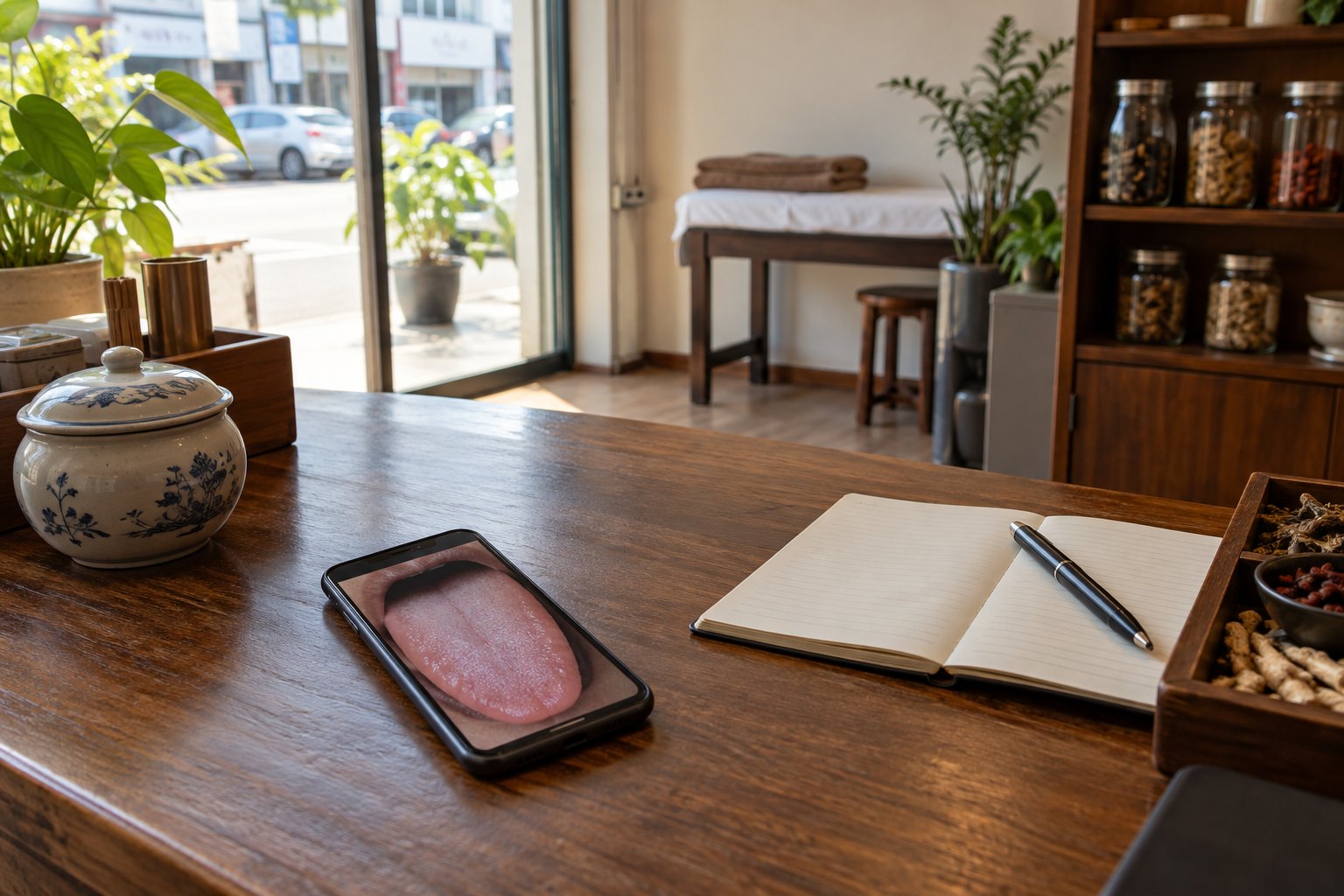
Have you ever been asked to stick out your tongue during a TCM consultation and wondered: what exactly is the practitioner looking at? Tongue diagnosis is a core part of the "observation" component of TCM's four diagnostic methods (observation, listening/smelling, inquiry, and pulse-taking). It has been used for thousands of years. It is not mystical — it is a structured way of gathering information about the body.
This article is written and reviewed by Amelia Gan, a registered TCM practitioner, to explain what tongue diagnosis is, how it works, and why it is a practitioner's tool — not a self-check checklist for readers.
What Tongue Diagnosis Does — An Information Map of the Body
Tongue diagnosis is observation, not diagnosis. A TCM practitioner looks at the tongue's colour, shape, coating (fur), moisture, and sublingual veins. In TCM theory, these features are understood as reflections of the body's internal state.
But tongue diagnosis is never used alone. A registered TCM practitioner will never draw a conclusion from the tongue alone. Findings from the tongue are cross-referenced with your consultation history, pulse diagnosis, constitution questionnaire, and other information to form a holistic picture.
A note: tongue diagnosis is a professional observation tool used by TCM practitioners. This article is for general education only and does not constitute an assessment of your personal health.
What Does a TCM Practitioner Actually Look For? — Four Observation Points
When examining the tongue, a practitioner typically observes four dimensions:
Tongue colour (body colour) — The overall colour of the tongue body, such as pale, red, or dark. In TCM theory, these colour variations are understood as reflections of qi, blood, or heat patterns.
Tongue shape (body form) — The size, thickness, teeth marks, and cracks on the tongue body. The same physical feature can be read completely differently in different people, so no single feature is ever interpreted on its own.
Tongue coating (fur) — The thickness, colour, moisture, and texture of the coating on the tongue surface. The quality and colour of the coating are understood in TCM theory as reflections of digestive function or internal damp-heat.
Sublingual veins — The colour and diameter of the veins under the tongue. In TCM theory, this is used as a reference for blood stasis.
The table below summarises these four observation points:
| Observation Point | What the Practitioner Looks At | TCM Theoretical Understanding |
|---|---|---|
| Tongue colour | Body colour: pink-red, red, dark red, or pale | Reflection of qi, blood, or heat patterns |
| Tongue shape | Size, thickness, teeth marks, cracks | Reflection of organ function states |
| Tongue coating | Thickness, colour, moisture, texture | Reflection of digestive function or damp-heat |
| Sublingual veins | Colour, diameter, tortuosity | Reference for "blood stasis" in TCM theory |
Please note: The table above is general information only. Tongue interpretation requires professional training and holistic judgment — it is not a lookup chart. The same tongue appearance can mean completely different things in different people.
Why Tongue Diagnosis Is Not a DIY Tool — Three Reasons
First, the tongue is easily influenced by many factors. Food, drinks, brushing, and even breathing patterns can temporarily change the tongue's appearance. A hot cup of coffee, a mint, or vigorous tooth brushing can all alter the coating temporarily. Without professional training, it is difficult to tell what is temporary and what is meaningful.
Second, a single tongue feature has no independent meaning. When a TCM practitioner looks at the tongue, they are holding it against your overall picture — sleep, diet, bowel habits, mood, menstrual cycle (if applicable), medical history, and more. A tongue photo alone is just one piece of the puzzle.
Third, tongue diagnosis requires experience. Distinguishing a "greasy" coating from a "thick" one, or a "pale" tongue from a "red" one, requires consistent clinical training. The skill is often described as one that takes years of clinical exposure to develop.
In an online consultation with HansMed, the system guides you through taking a clear tongue photo, and the practitioner interprets it together with your consultation history. The photo is one part of information gathering — not "photo in, diagnosis out."
How Online Tongue Diagnosis Works — Tips for Taking a Useful Tongue Photo
In HansMed's online consultations, the tongue photo is taken with the system's guidance; if it is not clear enough, the practitioner may observe the tongue directly during the video call. To take a useful tongue photo, please note the following:
- Lighting: Take the photo in natural light. Avoid yellow or white indoor lighting that can distort colour. Natural light near a window is ideal.
- Avoid staining foods: Before taking the photo, avoid coffee, tea, curry, blueberries, or anything that can stain the tongue.
- Do not scrape the coating: Do not brush or scrape your tongue before the photo — that changes its natural state.
- How to stick out your tongue: Extend it gently and relax. Do not strain — forceful extension temporarily changes the tongue's colour.
- Focus clearly: Make sure your phone camera focuses on the tongue surface, not on your face.
The purpose of these tips is to let the practitioner see the tongue as close to its natural state as possible. You do not need to judge your own tongue — that is the practitioner's job.
Tongue Diagnosis vs. Western Medical Examination — Two Systems, Different Roles
Tongue diagnosis belongs to the TCM theoretical framework, while Western medical examinations (blood tests, endoscopy, imaging) belong to a different medical system. The two are not mutually exclusive.
| Comparison | TCM Tongue Diagnosis | Western Medical Examination |
|---|---|---|
| Theoretical basis | TCM theory (qi, blood, organs, meridians) | Anatomy, physiology, pathology |
| Method | Visual observation of tongue features | Laboratory tests, imaging, endoscopy |
| Basis for judgment | Cross-referenced with consultation and pulse | Test data and pathological criteria |
| Suitable use | One input to a practitioner's holistic assessment, and the direction of ongoing care | Disease diagnosis and Western treatment |
The two can run in parallel. If you are receiving Western medical treatment and would also like TCM support, inform both practitioners about the care you are receiving. A TCM practitioner will never advise you to stop any medication prescribed by your doctor. Never stop prescribed medication on your own.
Frequently Asked Questions
Q: My tongue coating is thick — does that mean I have "dampness"?
A: A single tongue feature is not enough to draw any conclusion — which is exactly why tongue observation is only one of the four examinations. Coating thickness is also affected by diet, water intake, oral hygiene, and the lighting when the photo is taken. A practitioner reads the tongue together with the consultation, pulse information and everything else — never a single feature. Please do not interpret your own tongue from an article. If you would like to know about your situation, have a registered TCM practitioner assess it.
Q: My tongue has teeth marks — does that mean I have "spleen deficiency"?
A: Teeth marks alone are not enough to draw any conclusion. Tooth alignment, tongue size, and even the photo angle can create their appearance. A practitioner reads the tongue only together with the consultation and other information — never a single feature. Please do not interpret your own tongue from an article. If you would like to know about your situation, have a registered TCM practitioner assess it.
Q: Can tongue diagnosis detect cancer or other serious diseases?
A: No. Tongue diagnosis is an observational tool within the TCM theoretical framework. It cannot screen for or diagnose any Western-defined disease.
A note: this section is general information only. For conditions like these, follow your doctor's diagnosis and treatment, and seek medical attention when you need it.
Q: What if my tongue photo is not clear during an online consultation?
A: The system will guide you to retake the photo; if it is still not clear enough, the practitioner may observe the tongue directly during the video consultation. Online tongue observation is a supportive tool, not the sole basis for assessment.
Q: Can I scrape my tongue coating myself?
A: It is not recommended. Changes in the tongue coating reflect an underlying state; scraping the coating does not address the cause. If you have concerns about your tongue coating, consult a registered TCM practitioner. Using a tongue scraper as part of daily oral hygiene is a personal habit and is separate from TCM tongue diagnosis.
Conclusion: Tongue Diagnosis Is the Practitioner's Eyes, Not Your Mirror
The value of tongue diagnosis lies in professional interpretation, holistic context, and cross-referencing. It is one window through which a TCM practitioner observes the body — not a "tongue chart" for self-diagnosis. At your next online consultation, simply follow the system's guidance to take a clear photo, and leave the interpretation to the professional.
👉 If you are unsure how the tongue picture would actually be used in your consultation, you are welcome to book an online consultation with HansMed, where a practitioner registered under the T&CM Act 2016 can assess it with you.
Sit with a licensed TCM practitioner from wherever you are.
HansMed Modern TCM
For general wellness education only — not medical advice. Consult a registered TCM practitioner for personal guidance.


