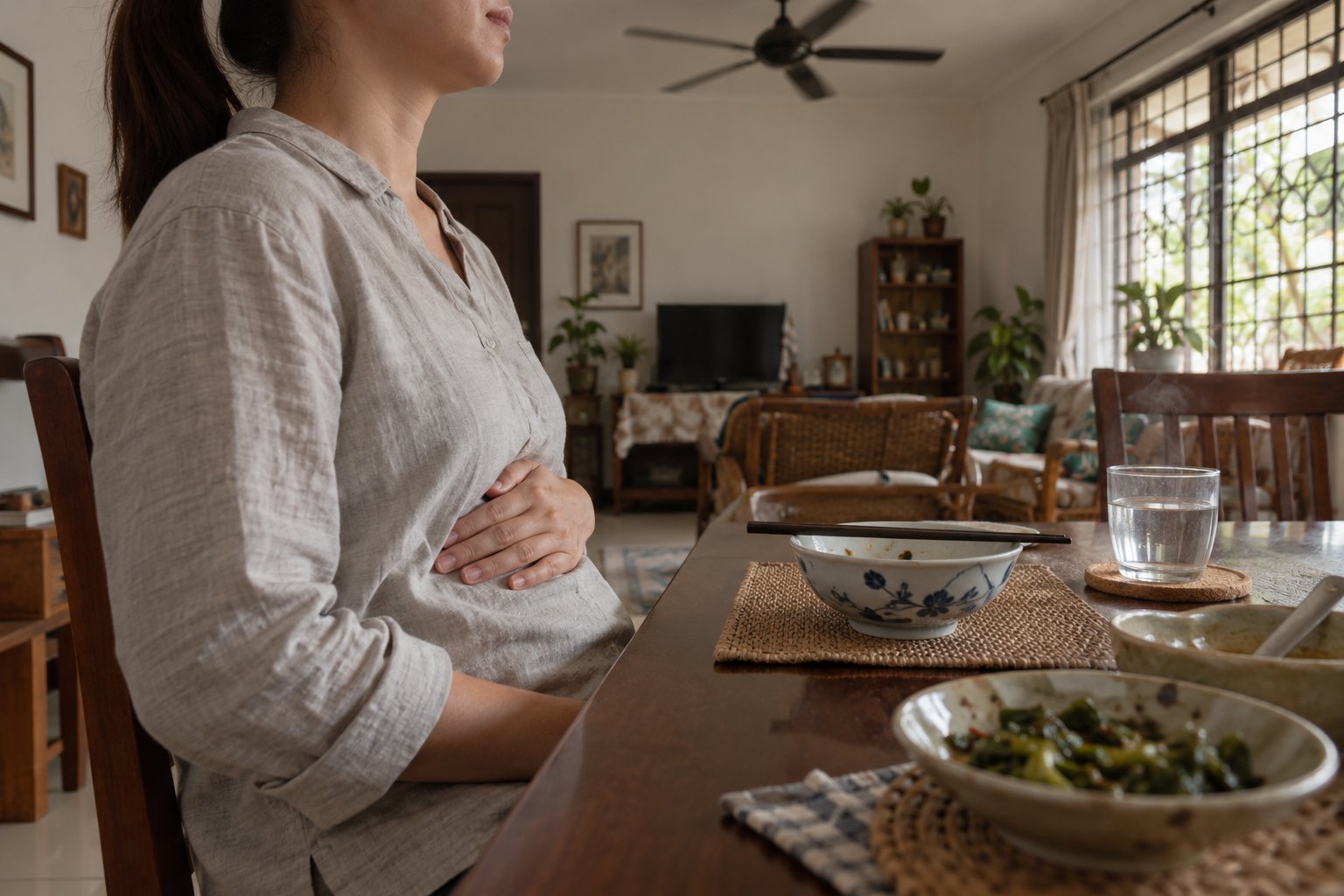
"My stomach has been off for a while." A sentence that comes up often is this one. But "stomach trouble" covers an enormous amount of ground: bloating, constipation, loose stools, feeling full after a few mouthfuls, sleepiness after meals, reflux at night.
The answer first. TCM theory treats the "gut" as a set of spleen-stomach functions: the spleen governs transportation and transformation; the stomach governs receiving and smooth downbearing. [WHO-2022] The theory's direction is four things: fixed meal times and portions, neither hungry nor overfull, food at a suitable temperature, chewing slowly. [CMRO-养生]
As for "does this count as constipation?" and "what do I do about reflux?", Western patient-information pages give a yardstick to hold it against. This article puts the two side by side, in 6 points.
I. How TCM theory sees the "gut"
The TCM "spleen" and "stomach" are not quite the anatomical organs; they are sets of functions. The World Health Organization's TCM terminology standard defines them this way:
- The spleen governs transportation and transformation: the spleen "digests water and food, absorbs and distributes nutrients and regulates water metabolism". [WHO-2022]
- The stomach governs receiving and holding: "The stomach receives and holds the water and food." [WHO-2022]
- The stomach governs smooth downbearing: "Stomach qi needs to be unobstructed and flows downward, so as to pass the primarily digested chyme down to the small intestine." [WHO-2022]
The theory reads everyday "stomach trouble" as one link in that chain being affected. That is why a consultation takes the sentence apart, which is section VI.
The theory has a stock phrase for the spleen-stomach's temperament: it likes warmth and dislikes cold (喜温恶寒). On the plate, the Hong Kong Department of Health's Chinese Medicine Regulatory Office lists meals "with appropriate temperature" [CMRO-饮食] and eating less cold-natured and raw-cold food [CMRO-养生] among its dietary principles.
Within that theory, "stomach trouble" is not one description but a set of different presentations:
- Appetite is fine, but you feel full after a little
- Bloating, sleepiness and heaviness after meals
- Constipation, or stools that do not hold together
- Alternating loose stools and constipation
- Reflux or burning, particularly at night
The theory keeps them apart. The table in section III is arranged by these five.
💡 Remember: the TCM "spleen-stomach" is the name of a set of functions, not a laboratory marker and not a disease name.
II. A yardstick first: what Western pages say about constipation and reflux
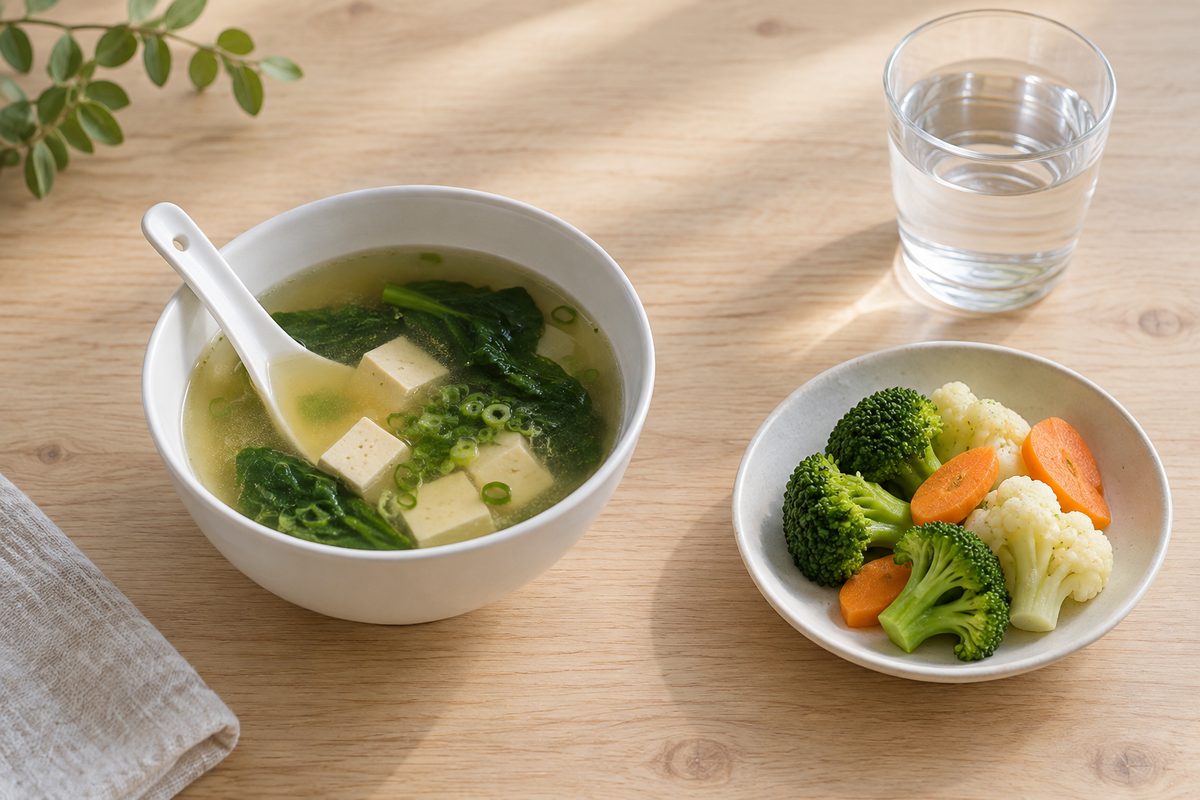
Theory gives direction; Western patient-information pages give definitions. The following is taken from the UK National Health Service's public pages, as a yardstick.
① What counts as constipation. The NHS says it is likely to be constipation if "you have not had a poo at least 3 times during the last week or you're pooing less often than usual". [NHS-便秘]
The same page lists three more: "the poo is unusually large or small and is dry, hard or lumpy", "you are straining or in pain when you have a poo", or "you feel like you haven't fully emptied your bowels". [NHS-便秘] So it is not only a count of days: how dry, how much straining, and whether it has changed from your usual all count.
The NHS also states that constipation "is also more common if you are over 65 years old" and "is common during pregnancy and after giving birth". [NHS-便秘]
② Stool shape has a chart. NHS England's Bristol Stool Chart divides stools into 7 types. [BRISTOL]
Type 1 is "Separate hard lumps, like nuts (hard to pass)", Type 4 "Like a sausage or snake, smooth and soft", Type 7 "Watery, no solid pieces. Entirely liquid". [BRISTOL] Saying "about a type 2" at a consultation is much clearer than "very hard".
The chart's note on constipation is a single sentence: "If a poo does not look like type 3 or type 4 it could be constipation." [BRISTOL] So types 3 and 4 are the chart's reference point.
A practitioner asks about shape because shape carries a direction: towards types 1 and 2, and towards types 6 and 7, are two different questions in the theory (rows 1 and 5 of the table in section III). Section V walks the constipation route.
③ What to do about reflux. The NHS advice is: "eat smaller, more frequent meals"; "do not eat within 3 or 4 hours before bed"; "do not wear clothes that are tight around your waist"; "do not smoke"; "do not drink too much alcohol"; "do not have food or drink that triggers your symptoms". [NHS-反酸]
The same page says you "may find that using wood, bricks or books to raise the head of your bed by around 10 to 20cm, so your chest and head are above your waist, helps relieve symptoms". [NHS-反酸]
But "do not try to achieve the same effect by using additional pillows, as this can increase pressure on your belly and make your symptoms worse". [NHS-反酸]
④ Who asks a pharmacist, who sees a doctor. If you keep getting heartburn, the NHS says speak to a pharmacist, who may recommend medicines called antacids. [NHS-反酸]
See a doctor if "lifestyle changes and pharmacy medicines are not helping your heartburn", "you have heartburn most days", or "you also have other symptoms, like food getting stuck in your throat, frequently being sick, or losing weight for no reason". [NHS-反酸] Food stuck in the throat or difficulty swallowing means seek care the same day. [NHS-吞咽]
If you are on medication, the NHS's own words are: "do not stop taking any prescribed medicine without speaking to a doctor first". [NHS-反酸] Never stop your medication on your own.
For Chinese herbs alongside Western medication, see Can Chinese herbs be taken with Western medicine.
⚠️ A note: this yardstick is for describing, not for self-diagnosis. If the definition fits, the next step is a doctor or a pharmacist, not your own prescription.
III. One table: five situations, what the theory says, the usual practice, when to see a doctor first
| Situation | What TCM theory says | Usual practice | When to see a doctor first |
|---|---|---|---|
| Constipation (fewer than 3 times a week, dry and hard, straining [NHS-便秘]) | The large intestine governs conveyance: it "conducts wastes and discharges faeces" [WHO-2022]; the theory holds that when the propelling force is weak, stools do not pass easily; the spleen governs transportation and transformation [WHO-2022], which the theory holds to be the upstream handling of fluids and nutrients | A regular time for the toilet, do not delay the urge, drink plenty of water, increase fibre gradually (the NHS's stated purpose: "To make your poo softer and easier to pass"), a daily walk [NHS-便秘]; the theory's direction is fixed meal times and warm food | Not improving with treatment, regularly constipated, blood in your poo, weight loss without trying, tummy pain [NHS-便秘]; poo black or dark red means seek care the same day [NHS-便血]; bleeding non-stop or a lot of blood means call 999 now [NHS-便血] |
| Bloating and sleepiness after meals | The spleen governs transportation and transformation [WHO-2022]; the theory holds that an overfull or oily meal loads that work; dietary irregularities: "Improper diet, including excessive hunger and binge eating" [WHO-2022] | Neither hungry nor overfull (what Malaysians call "七分饱"), chew slowly [CMRO-养生]; walk a little after eating, do not lie down straight away (the theory's direction) | Bloating that does not go away or keeps coming back, with stomach ache, means seek care the same day [NHS-腹痛]; weight loss without trying means see a doctor first [NHS-便秘] |
| Reflux or burning, especially at night | The stomach governs smooth downbearing [WHO-2022]; the theory holds that stomach qi should flow downward, and reads reflux as stomach qi rising against that direction; the standard: this "often occurs when cold, heat, diet or emotions causes stomach qi to ascend" [WHO-2022] | Smaller, more frequent meals; nothing to eat within 3 or 4 hours of bed; head of the bed raised 10 to 20cm (the NHS: symptoms "are often worse after eating, when lying down") [NHS-反酸]; the theory's direction is an earlier, lighter dinner | Heartburn most days, frequently being sick, losing weight for no reason [NHS-反酸]; food stuck in the throat or difficulty swallowing means seek care the same day [NHS-吞咽]; vomiting blood means call 999 now, or go to the nearest hospital emergency department [NHS-腹痛] |
| Full after a little, gassy | The stomach governs receiving and holding [WHO-2022]; the theory holds that spleen and stomach are an interior–exterior pair: the stomach receives, the spleen transports and transforms, and when transporting falls short, receiving shrinks too; the stomach governs decomposition: it "primarily digests water and food and forms chyme" [WHO-2022] | Smaller, more frequent meals; a warm drink with the meal, iced drinks between meals (the theory's direction) | Difficulty swallowing or food stuck in the throat means seek care the same day [NHS-吞咽]; cannot poo or fart means call 999 now [NHS-腹痛] |
| Stools that do not hold together, or alternating with constipation | The spleen governs transportation and transformation, including water metabolism [WHO-2022]; the theory holds that when fluid handling falters, stools lose form; the large intestine governs the thin body fluids: it "absorbs the thin, clear fluids while eliminating waste" [WHO-2022] | Eat less cold-natured and raw-cold food [CMRO-养生]; keep three days of food and stool notes and bring them to the consultation | A sudden change in bowel habit, blood in your poo, weight loss without trying [NHS-便秘]; bloody diarrhoea means seek care the same day [NHS-便血]; diarrhoea that does not go away after a few days, with stomach ache, means seek care the same day [NHS-腹痛] |
In the table, "seek care the same day" means a same-day visit to a Klinik Kesihatan or clinic; the "call 999 now" situations do not wait for a clinic.
The "what TCM theory says" column is how the theory explains it, not a judgement about you.
💡 Remember: the fourth column lists situations that get mixed up with "stomach trouble" and should be ruled out by a Western doctor first. Rule out first, then adjust.
IV. See a doctor first in these situations
Some digestive symptoms need investigation to establish the cause. See a doctor first — do not rely on TCM care alone — if there is:
- Blood in the stool, or stools that look black — black or dark red means seek care the same day [NHS-便血]
- Weight loss you did not intend
- Difficulty swallowing, or a sensation of food sticking — seek care the same day [NHS-吞咽]
- Persistent vomiting, or being unable to eat or drink — vomiting blood means call 999 now, or go to the nearest hospital emergency department [NHS-腹痛]
- Severe abdominal pain, or pain that stops you functioning — see the safety note below
- Persistent fever alongside abdominal pain
- A marked change in bowel habit in an older adult
These need medical investigation — including endoscopy or imaging where indicated — and a TCM consultation does not substitute for them. "Seek care the same day" means a same-day visit to a Klinik Kesihatan or clinic.
⚠️ A safety note: TCM and Western medicine complement each other; it is not a choice between them. For heavy bleeding [NHS-便血], severe abdominal pain [NHS-腹痛], if you cannot poo or fart [NHS-腹痛], or vomiting blood [NHS-腹痛], call 999 now, or go to the nearest hospital emergency department.
A note: this section is general information only. For conditions like these, follow your doctor's diagnosis and treatment, and seek medical attention when you need it.
V. How it actually happens: reflux and constipation, each side's own model

So far, the theory's account and the Western yardstick. This section goes one step in: how reflux and how constipation happen, in each of the two accounts. The two are written separately, each under its own source.
Where the World Health Organization's 2022 TCM terminology standard is quoted below it is called "the standard"; only definition sentences are quoted, never a symptom list.
① Reflux: how the NHS explains it. The NHS definition is that heartburn is "a burning feeling in the chest caused by stomach acid travelling up towards the throat (acid reflux)". [NHS-反酸]
The same page states that symptoms "are often worse after eating, when lying down and when bending over". [NHS-反酸] So "do not eat within 3 or 4 hours before bed" has a reason behind it: lying down on a full stomach stacks two of those moments on top of each other.
The NHS also gives the logic of raising the bed: with your chest and head above your waist, it "can help stop stomach acid travelling up towards your throat"; extra pillows instead "can increase pressure on your belly and make your symptoms worse". [NHS-反酸]
② Reflux: how TCM theory explains it. The standard describes "the stomach governs smooth downbearing" (胃主通降) as: "Stomach qi needs to be unobstructed and flows downward, so as to pass the primarily digested chyme down to the small intestine." [WHO-2022] The theory's stock phrase 「胃气以下行为顺」, stomach qi is in order when it moves downward, means this direction.
The last sentence of the standard's entry on stomach qi ascending (in its patterns chapter) states that it "often occurs when cold, heat, diet or emotions causes stomach qi to ascend". [WHO-2022] The theory reads reflux as stomach qi moving up against its proper direction; diet is one of the causes the standard names.
The two accounts look at the same experience: something travelling upward. One speaks of stomach acid and body position, the other of the direction of "qi". They are not translations of each other; each stands on its own.
That is why "what time did you eat, and how long after did you lie down" are questions both sides ask.
③ Constipation: how the NHS explains it. The NHS's common causes of constipation in adults include "not eating enough fibre, which is found in fruits, vegetables and cereals", "not drinking enough fluids", "not moving enough and spending long periods sitting or lying down", "often ignoring the urge to go to the toilet", "changing your diet or daily routine" and "a side effect of medicine". [NHS-便秘]
The NHS measures answer that list. Drinking plenty of water and gradually increasing fibre are, in its words, "To make your poo softer and easier to pass". [NHS-便秘]
Toilet routine: "Keep to a regular time and place and give yourself plenty of time to use the toilet", and "Do not delay if you feel the urge to poo"; activity: "A daily walk or run can help you poo more regularly". [NHS-便秘]
On the medicine item, the NHS's own words are: "Speak to the GP before you stop taking any prescribed medicine." [NHS-便秘] Never stop your medication on your own.
④ Constipation: how TCM theory explains it. Along the route from intake to exit, the standard has a separate definition for each of these segments:
- The spleen governs transportation and transformation (脾主运化): the spleen "digests water and food, absorbs and distributes nutrients and regulates water metabolism". [WHO-2022]
- The small intestine separates the clear from the turbid (小肠泌别清浊): it "absorbs nutrients and body fluids and passes the food residue and water down to the large intestine". [WHO-2022]
- The large intestine governs conveyance (大肠主传导): it "conducts wastes and discharges faeces". [WHO-2022]
- The large intestine governs the thin body fluids (大肠主津): it "absorbs the thin, clear fluids while eliminating waste". [WHO-2022]
So within the theory, how dry the stool is has to do with how fluids are handled along that route, and whether it moves has to do with whether qi is stagnant. Those two sentences are the theory's common teaching; the standard does not join them up that way.
The standard's entry on "physical inactivity" (过逸) states that it "leads to imbalances in the flow of qi and blood, weak tendons and bones, stagnant qi of the spleen and stomach". [WHO-2022] The "a daily walk" cell in section III's table has a reason on each side.
⑤ One week, two readings. Below, an ordinary week is laid under both models. It describes how each model reads these habits, not any particular reader, and it is not a diagnosis.
- Monday to Friday: breakfast in the car, nasi campur with little veg at lunch, overtime dinner from a delivery app. On the NHS's cause list this is "not eating enough fibre". [NHS-便秘] The theory sees "dietary irregularities" (饮食不节), which the standard defines as "Improper diet, including excessive hunger and binge eating". [WHO-2022]
- All day in an air-conditioned room, the water bottle barely touched. NHS: "not drinking enough fluids". [NHS-便秘] The theory's common teaching: when fluids are short the large intestine loses its moistening and the stool turns dry; "the large intestine governs the thin body fluids" is about the water in exactly that segment.
- The urge arrives in a meeting and is held until it ends. The NHS's own words are "Do not delay if you feel the urge to poo". [NHS-便秘] The theory reads this as "conveyance" interrupted: what should move down stays where it is; that too is common teaching.
- Over the week, far more time sitting than walking. NHS: "not moving enough and spending long periods sitting or lying down". [NHS-便秘] The standard: "physical inactivity", "stagnant qi of the spleen and stomach". [WHO-2022]
- Sunday, looking back: two stools that week, and towards types 1 and 2. By the NHS yardstick, fewer than 3 times during the last week is likely to be constipation. [NHS-便秘] By the Bristol chart, "If a poo does not look like type 3 or type 4 it could be constipation". [BRISTOL]
- Where the two readings land. The NHS lands on fibre, fluids, toilet routine and activity; the theory lands on transformation, conveyance and "movement". They overlap on habits; their sources differ.
This passage describes the models, not a diagnosis. The same week landing on different people can turn out differently; the NHS itself states that "Sometimes there's no obvious reason". [NHS-便秘]
If the definition of constipation fits, the next step is the one in section II: a pharmacist or a doctor; with any item from section IV, a doctor first.
💡 Remember: the two accounts of reflux look at the same "upward"; the two accounts of constipation look at the same "downward" route. The habit advice overlaps because both are looking at the same thing, not because they are the same theory.
VI. What an online consultation does, and what needs an in-person visit or a doctor
With the theory and the yardstick covered, the last thing is how "my kind of stomach" is handled inside a consultation.
① The five directions a practitioner asks about. What you eat and when; how you feel after eating; the frequency, form and colour of your stools; the link to mood and routine; and other signals: dry or bitter mouth, appetite, sleep, weight.
The practitioner also asks whether you have seen a doctor, what tests you had and what medication you took. What has already been ruled out is information too.
② Why the tongue, and what the photo has to show. The World Health Organization's terminology standard defines tongue diagnosis as "A diagnostic method to inspect the patient's tongue body and tongue coating". [WHO-2022] So the photo has to show two layers: the tongue body, and the coating on top of it.
The standard's definitions: the tongue body "includes the musculature and vascular tissue of the tongue" [WHO-2022]; the tongue coating is "A layer of moss-like material covering the tongue, generated by ascending of stomach qi". [WHO-2022] Looking at the coating when asking about the gut: the theory's link is the phrase "stomach qi".
The standard defines tongue manifestations (舌象) as "changes in the appearance of the tongue, including changes in the spirit, colour and form of the tongue body and its coating". [WHO-2022] Those three, spirit, colour and form, are what the practitioner looks at.
What a given colour, or a thick or thin coating, means is a judgement made after the consultation; it is outside this article, and not something to match against a list yourself.
An online consultation works from the tongue photo you take. Lighting, timing, angle and the common mistakes are in how to take a useful tongue photo.
③ What cannot be done online, the practitioner will say. Pressing on the abdomen and listening with a stethoscope cannot be done online; investigations such as endoscopy, ultrasound and blood tests are a doctor's.
If the practitioner thinks a Western medical check should come first, they say so.
④ Three possible directions: acupuncture, Chinese herbs, and lifestyle adjustments. The herbs may be concentrated granule powder or a decoction; the lifestyle side means the kind of habits in section III.
Which, and whether, is decided after the consultation, and the practitioner's written instructions take precedence.
⑤ Reminders by situation, not by constitution:
- On long-term medication: tell the practitioner everything you take; the NHS's own words are "do not stop taking any prescribed medicine without speaking to a doctor first". [NHS-反酸] Never stop your medication on your own.
- Pregnant, trying, or breastfeeding: the NHS states that constipation is common during pregnancy and after giving birth, and that "It's safe to try these simple measures when you're pregnant"; for heartburn medicines in pregnancy, "a pharmacist can advise you about medicines you can take". [NHS-便秘][NHS-反酸] Whether herbs or acupuncture suit you, ask the practitioner first.
- Under 12: the NHS constipation page states "This page is about constipation in adults. There's separate information on constipation in babies and children." [NHS-便秘] For a child's digestion, see a paediatrician first.
- Older adults: the NHS states constipation is more common over 65, and that when caring for an older person "constipation may be easily missed". [NHS-便秘] A marked change in bowel habit: see section IV.
- Before surgery, or a chronic condition under regular review: tell your doctor the herbs, herbal teas and supplements you take, and let the doctor judge.
What to prepare beforehand is in what to prepare before an online consultation.
Fitting it into life in Malaysia
- Kopi peng or teh ais with rice: the theory's direction is a warm drink with the meal; if you really want it iced, have it between meals. That is a direction for a habit, not a ban.
- Mamak suppers: the NHS says "do not eat within 3 or 4 hours before bed". [NHS-反酸] The theory says an earlier, lighter dinner. In overtime season and exam season, say what time and how often at the consultation.
- All day in an air-conditioned office: the NHS lists "not moving enough and spending long periods sitting or lying down" among common causes of constipation and suggests considering more activity, such as a daily walk. [NHS-便秘] The theory says "move": a walk after meals.
- Holding it in: meetings, deadlines, classes. The NHS's own words are "Do not delay if you feel the urge to poo", and it advises keeping to a regular time and place and giving yourself plenty of time. [NHS-便秘]
- Chilli pan mee, curry, steamboat, durian season, festive meals: no need to give them up before the consultation. The NHS practice is to avoid "food or drink that triggers your symptoms" [NHS-反酸]; the operative word is "your", so describe how you actually eat.
- Antacids from the pharmacy (Guardian, Watsons): if you keep getting heartburn, the NHS says ask a pharmacist first; antacids help symptoms in the short term and "should not be taken regularly for long periods". [NHS-反酸]
- Herbal-tea-shop teas, direct-sales enzymes and probiotics: mention them all at the consultation; the practitioner looks at them together.
- Confinement (坐月子): constipation after giving birth is common [NHS-便秘]; confinement diets have their own arrangements, so whether something suits yours is a question for the practitioner in charge, not an online recipe.
Frequently asked
How long before it counts as constipation? The NHS says it is likely to be constipation if you "have not had a poo at least 3 times during the last week" or are "pooing less often than usual"; poo that is "dry, hard or lumpy", "straining or in pain", or feeling you "haven't fully emptied your bowels" count too. [NHS-便秘] See a doctor if you are regularly constipated, it is not getting better with treatment, there is blood in your poo, or you have lost weight without trying [NHS-便秘]; blood in your poo for 3 weeks also means see a doctor. [NHS-便血] Bleeding non-stop or a lot of blood means call 999 now, or go to the nearest hospital emergency department. [NHS-便血]
Is feeling sleepy after meals normal? In TCM theory, "transportation and transformation" is the spleen's work of digesting food and absorbing and distributing nutrients. [WHO-2022] TCM theory holds that after a meal the spleen-stomach is busy with exactly that, and after an overfull or oily meal the drowsiness is more marked — a statement about habit, not a diagnosis of you. The direction is neither hungry nor overfull, chew slowly [CMRO-养生], and walk a little afterwards. With weight loss without trying or blood in your poo, see a doctor first [NHS-便秘]; bloating that does not go away, with stomach ache, means seek care the same day. [NHS-腹痛]
Do cold drinks really harm the stomach? "Harm the stomach" is TCM theory's language: the spleen-stomach likes warmth and dislikes cold, so meals "with appropriate temperature" [CMRO-饮食] and eating less cold-natured and raw-cold food [CMRO-养生] are that theory's standard counsel. It describes the direction of a habit, not a prediction of what one glass will do. It is hot here and iced drinks are routine; all the theory would change is drinking ice through the meal itself — a warm drink with the meal, iced drinks between meals.
What can I do about bloating right now? Get up and walk a little, do not lie down straight away; loosen clothes that are tight around your waist; stop this meal at seven-tenths full; switch to a warm drink. The NHS lists "feeling bloated, farting a lot" as a possible sign of trapped wind and says a pharmacist can help. [NHS-腹痛] Bloating that does not go away or keeps coming back, with stomach ache, means seek care the same day; if you cannot poo or fart, call 999 now, or go to the nearest hospital emergency department. [NHS-腹痛]
When do I need a gastroscopy? The doctor decides. The NHS says that if medicines do not help or symptoms are severe, a GP may refer you to a specialist for tests such as a gastroscopy. [NHS-反酸] The NHS lists as reasons to see a GP: heartburn most days, food getting stuck in your throat, frequently being sick, losing weight for no reason [NHS-反酸]; of these, food stuck in the throat or difficulty swallowing means seek care the same day. [NHS-吞咽] Vomiting blood means call 999 now, or go to the nearest hospital emergency department. [NHS-腹痛]
Why does TCM look at the tongue for the gut? The World Health Organization's terminology standard describes the tongue coating as "generated by ascending of stomach qi". [WHO-2022] The coating relates to stomach qi, so looking at the tongue when asking about the gut is the theory's internal logic. An online consultation works from your photo: morning before brushing, natural light, not straight after a kopi. Details in how to take a useful tongue photo.
In closing
✅ Worth remembering:
- TCM theory treats the "gut" as spleen-stomach functions: the spleen governs transportation and transformation; the stomach governs receiving and smooth downbearing. [WHO-2022]
- The theory's direction is fixed meal times and portions, neither hungry nor overfull, food at a suitable temperature, chewing slowly. [CMRO-养生]
- The Western yardstick: fewer than 3 poos in the last week is likely constipation [NHS-便秘]; for reflux, do not eat within 3 or 4 hours before bed, and raise the head of the bed 10 to 20cm. [NHS-反酸]
- Blood in the stool, weight loss without trying, persistent vomiting: see a doctor for tests first; black or dark red poo, difficulty swallowing: seek care the same day. Heavy bleeding, cannot poo or fart, or vomiting blood: call 999 now, or go to the nearest hospital emergency department.
- Reflux: the NHS says it is stomach acid travelling up, worse after eating and when lying down [NHS-反酸]; the theory says stomach qi is in order when it moves downward. [WHO-2022] Constipation: the NHS lands on fibre, fluids, toilet routine and activity [NHS-便秘]; the theory lands on transformation and conveyance. [WHO-2022]
- An online consultation asks five directions and looks at your tongue photo; pressing on the abdomen needs an in-person visit, and investigations are a doctor's.
❌ Do not:
- Clean up your diet just before the consultation to "look better" — the practitioner needs the real version.
- Rely on TCM care alone when there is blood in the stool or unintended weight loss.
- Never stop prescribed medication on your own because you have started TCM care.
👉 If you are unsure where to even start describing your digestive situation, you are welcome to book an online consultation with HansMed, where a practitioner registered under the T&CM Act 2016 can assess it with you.
Reviewed by Ms. Koo Shuang, a TCM practitioner registered with Malaysia's Traditional and Complementary Medicine Council under the T&CM Act 2016, practising in gastroenterology, dermatology, respiratory and women's health.
Sit with a licensed TCM practitioner from wherever you are.
HansMed Modern TCM
For general wellness education only — not medical advice. Consult a registered TCM practitioner for personal guidance.


