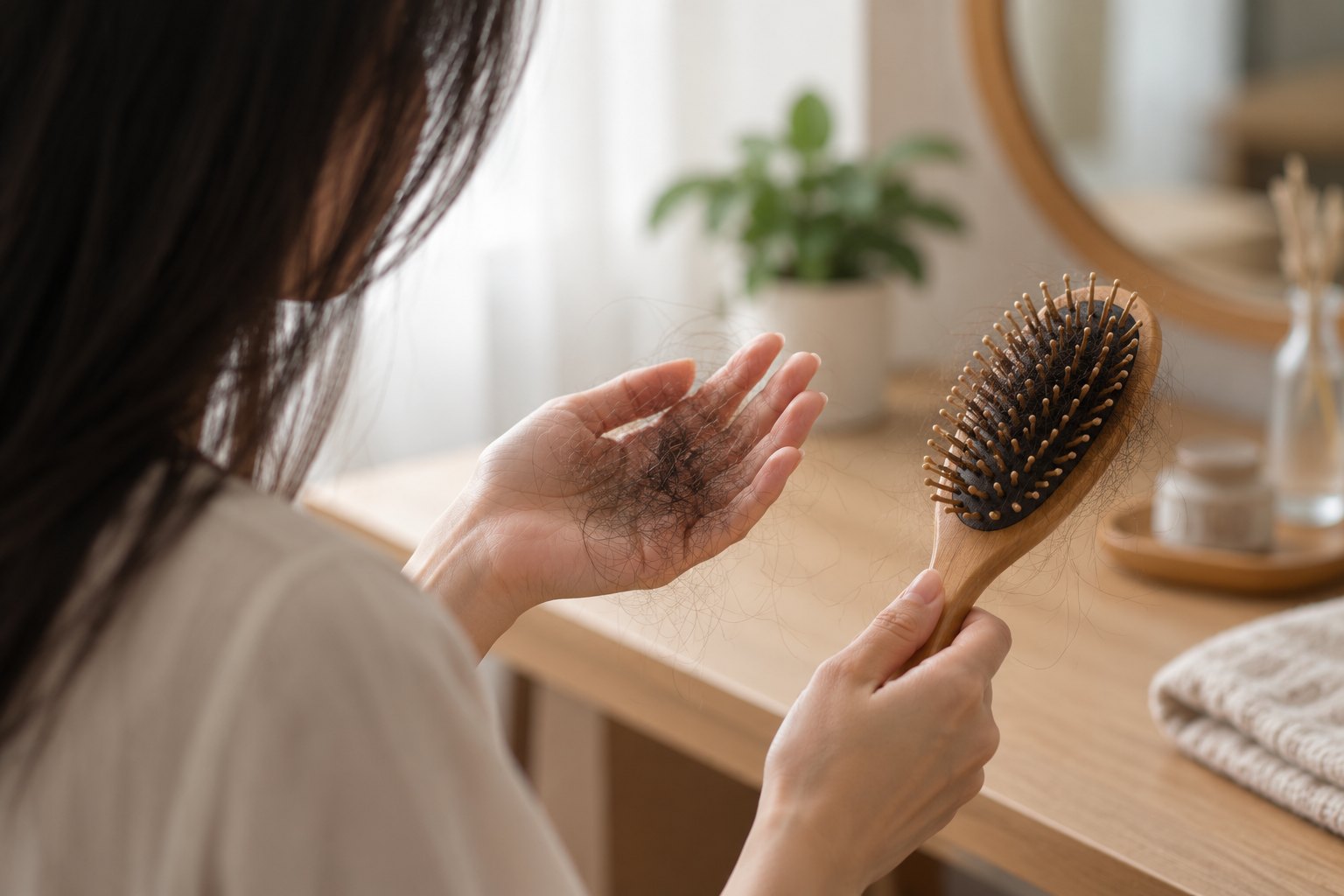
"I've been losing a lot of hair — a handful every time I wash it." It is a sentence that comes up often.
This article does not recommend products, and does not tell you what to take to grow it back. It is about what a practitioner asks, and when to see a dermatologist first, set out as 5 things.
I. First: the pattern matters more than the amount
It is easy to describe hair loss by quantity alone. A practitioner is more interested in distribution and form — these distinctions mainly help decide whether a dermatologist should come first; TCM assessment still rests on the whole picture:
- Thinning overall, or noticeably worse in particular areas
- A receding hairline, or thinning through the crown
- Round, distinct bald patches — this one needs a doctor first
- Along with flaking, redness, itching or soreness — this one too
- Whole hairs with the root, or hairs breaking mid-shaft
How TCM understands the relationship between hair and the overall state belongs to the theoretical framework of the organ systems and qi — a different kind of explanation from a dermatological account of the follicle cycle. The two should not be conflated.
💡 Remember: a photograph beats a description. Good light, the same angle, taken again after an interval, is far clearer than "a lot".
II. The 5 things a practitioner asks about
- When it started and how it changed — when you noticed, sudden or gradual, whether it is worsening.
- Distribution and form — the questions in the section above.
- What else happened around that time — illness, fever, surgery, childbirth, marked weight change, a period of severe stress.
- The condition of the scalp — oiliness, flaking, itching, redness, spots or sores.
- Existing diagnoses and medication — what you take, supplements, thyroid or anaemia results, whether anyone in the family has something similar.
The third is the easiest to skip and it is critical — a practitioner asks about the months before as well, not only the last few days.
💡 Remember: being asked what happened three or four months ago is not a detour. It is a standard move in this kind of consultation.
III. How to describe it usefully
| Instead of | Say |
|---|---|
| "A lot is falling out" | "A handful in the drain when I wash, and some on the pillow" |
| "My hair is thinner" | "Scalp clearly visible through the crown; the sides are fine" |
| "It started recently" | "About three months ago, after childbirth / after being ill" |
| "My scalp feels off" | "Oily and itchy, with a red flaking patch" |
| "I'm using something for it" | "Bought online, two months now, not sure of the ingredients" |
This table deliberately does not say what any answer means. TCM is not a self-assessment quiz — and some of these need a dermatologist's examination to establish at all.
IV. See a dermatologist or doctor first in these situations
- Round, well-defined bald patches
- A scalp that is red, swollen, weeping, crusted or clearly painful — if it comes with a high fever, facial swelling or feeling unwell in yourself, call 999 now, or go to the nearest hospital emergency department
- Sudden heavy loss over a short period
- Marked weight change, heat or cold intolerance, or palpitations alongside it — thyroid testing may be needed
- In women, alongside changes to periods or body hair
- During or just after particular treatments (chemotherapy, for instance) — follow your treating doctor's plan
- Hair loss that began after starting a new medication — tell your doctor, and never stop it on your own
- An ulcer or new growth on the scalp that does not heal
These need a doctor's examination — including blood tests or scalp examination where indicated — to establish the cause, and a TCM consultation does not substitute for them.
⚠️ A safety note: TCM and Western medicine complement each other; it is not a choice between them. Products and treatments marketed for hair growth are widely available; anything of unclear composition or origin is not something to use on your own, and whatever you are using should be mentioned to both your doctor and your practitioner.
A note: this section is general information only. For conditions like these, follow your doctor's diagnosis and treatment, and seek medical attention when you need it.
V. Fitting it into life in Malaysia
- Heat, sweat, washing daily. Very common here — say honestly how often and what you use.
- Commuting in a helmet. Heat, friction and sweat; how many hours a day is worth a sentence.
- Colouring and perming. How often, when the last time was, and whether it started after.
- Hair loss after childbirth. Always mention that timing. On postnatal consultations: confinement.
- Photograph it. Same angle, same light, taken again after an interval. More useful than any description.
On preparing: what to prepare before an online consultation.
In closing
✅ Worth remembering:
- Distribution and form matter more than how much is falling out.
- A practitioner asks about onset, pattern, what else happened at the time, the scalp, and existing diagnoses and medication.
- Asking back three or four months is standard, not a detour.
- Round bald patches, a red or weeping scalp, sudden heavy loss — see a dermatologist first.
- If it began after a new medication, tell your doctor and do not stop it on your own.
❌ Better not to:
- Buy products before establishing which situation this is.
- Use hair-growth products of unclear composition or origin.
- Rely on TCM care alone when the scalp is red, weeping or painful.
👉 If you would like to set the whole picture out for a practitioner, you are welcome to book an online consultation with HansMed, where a practitioner registered under the T&CM Act 2016 can assess it with you; if anything in section IV applies, see a dermatologist or doctor first.
Reviewed by Ms. Koo Shuang, a TCM practitioner registered with Malaysia's Traditional and Complementary Medicine Council under the T&CM Act 2016, practising in gastroenterology, dermatology, respiratory and women's health.
Sit with a licensed TCM practitioner from wherever you are.
HansMed Modern TCM
For general wellness education only — not medical advice. Consult a registered TCM practitioner for personal guidance.