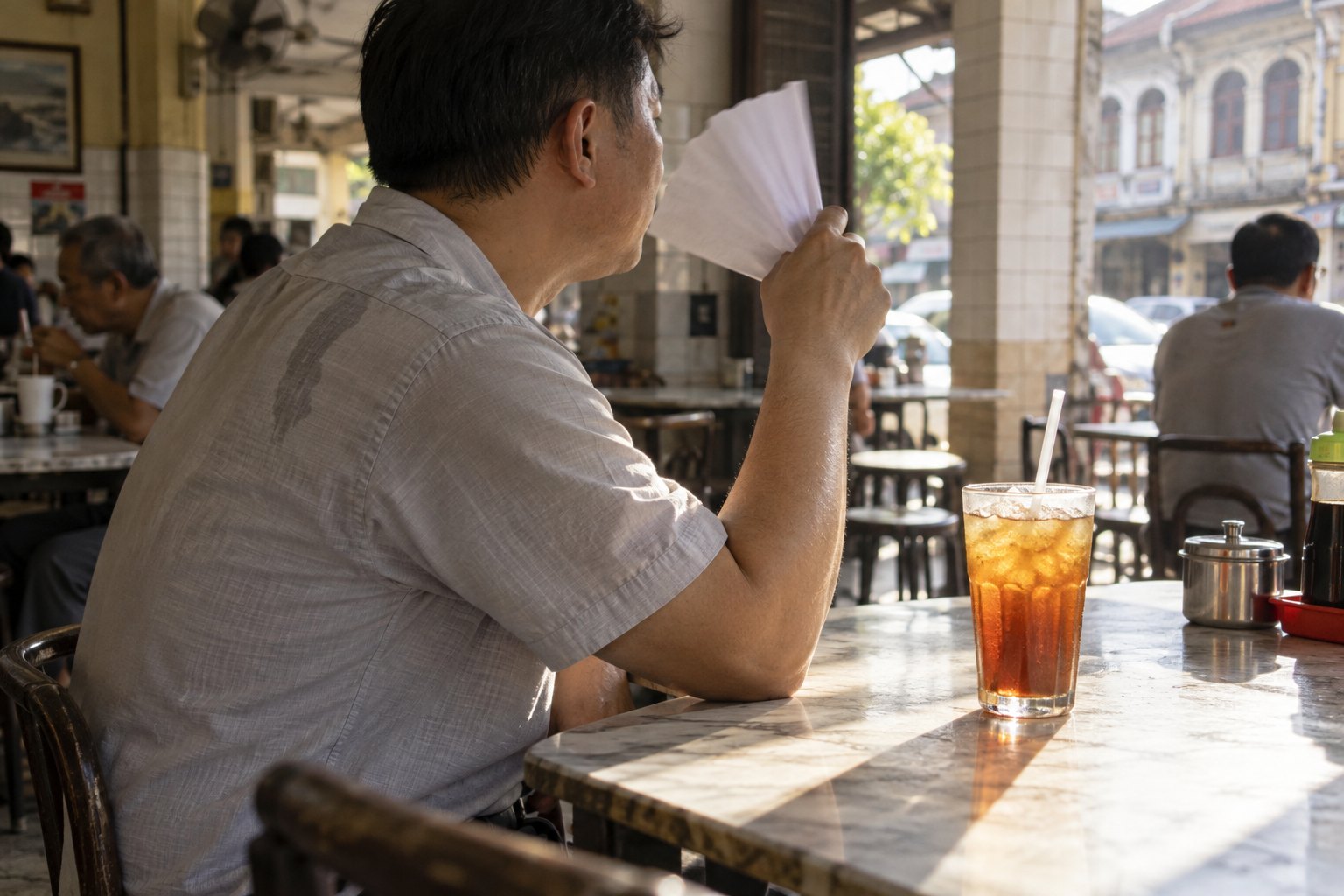
"Feeling 'heaty' lately?" — this phrase is heard almost daily in Malaysian coffee shops, offices, and family gatherings. A sore throat is blamed on shang huo. Acne is blamed on shang huo. A short temper is blamed on shang huo. But what exactly is shang huo? Is it a precise TCM diagnosis, or just a convenient catchphrase?
This question comes up constantly. Many people treat shang huo as a universal explanation without necessarily understanding what it means within the framework of TCM theory. This article does not discuss how to "reduce heatiness." It only clarifies what shang huo refers to and corrects five common misconceptions.
What "Shang Huo" Means in TCM Theory
In TCM theory, "fire" (火) is a metaphor used to describe a state of the body. It does not mean an elevated body temperature, nor is it synonymous with inflammation. TCM uses "fire" to describe patterns that lean toward "heat" and "excess activity," such as dry mouth, throat discomfort, restlessness, poor sleep, or darker urine. These experiences are often described as "heatiness" or "excessive fire."
However, shang huo is not a formal diagnostic label. It is more of a colloquial umbrella term that may correspond to several different theoretical frameworks, such as "excess fire" (实火), "deficient fire" (虚火), "liver fire" (肝火), or "stomach fire" (胃火). Each type of "fire" has different origins and presentations, and the approach to care differs accordingly. Therefore, the term shang huo alone is insufficient to determine any specific course of action.
Misconception 1: "Shang Huo" Means the Body Is Too Hot
This is the most common misunderstanding. Equating shang huo with a high body temperature or hot weather is not accurate. In TCM theory, "fire" describes a functional state, not a number on a thermometer. What is described as shang huo can appear even in an air-conditioned room. Conversely, hot weather does not mean everyone will develop shang huo.
In TCM theory, "fire" and "heat" belong to the same theoretical family, but "fire" is generally understood as a more concentrated and pronounced manifestation of heat. This is a TCM theoretical framework and is not the same as the modern physiological concept of temperature regulation.
Misconception 2: "Shang Huo" Is Always Caused by Food
Many people assume shang huo is solely related to diet, especially fried foods, spicy dishes, durian, or mangoes. Diet is indeed one factor considered in TCM theory, but it is not the only one. Insufficient sleep, stress, emotional fluctuations, and chronic late nights may also be associated with "fire" in TCM theory.
In other words, shang huo is not necessarily the result of "eating the wrong thing." Blaming food alone may cause one to overlook the equally important roles of rest and emotions.
Misconception 3: "Shang Huo" Is the Same as "Inflammation" in Western Medicine
This is a widespread confusion. In Western medicine, "inflammation" has a specific pathological definition involving immune responses and tissue changes, observable through tests and imaging. TCM's "fire," by contrast, is a concept within its theoretical framework used to group a set of presentations. The two are not equivalent.
A person with shang huo-like presentations may have completely normal blood test results. Conversely, a condition diagnosed as inflammation by Western medicine may not fit the TCM description of "fire." Equating the two does not help one understand their own body.
Misconception 4: "Shang Huo" Is a Permanent Constitution That Cannot Change
Some people think they are "naturally prone to shang huo" and treat it as a fixed label. But in TCM theory, the body's state is dynamic. What is described as "fire" may shift with sleep, diet, emotions, and seasons. It is not a lifelong verdict, but a description of the current state.
That said, this does not mean shang huo can be managed on one's own. If presentations described as shang huo recur, it is advisable to seek a registered TCM practitioner for a full pattern differentiation rather than continuing to guess.
Misconception 5: "Reducing Fire" Is All You Need
This is the misconception that requires the most caution. Many people, upon feeling shang huo, immediately purchase cooling herbal drinks, TCM patent medicines, or various "heat-reducing" products. But as noted, shang huo is a broad term that may correspond to different theoretical frameworks. Without proper differentiation, blindly "reducing fire" may not help and may even be unsuitable for the current state.
In TCM theory, if the pattern is one of "deficient fire" and one mistakenly applies a "draining fire" approach, it may theoretically be counterproductive. Therefore, rather than self-prescribing "heat-reducing" measures, it is better to first clarify whether one truly has shang huo, and if so, which type it is.
When to Seek Medical Attention
If any of the following occur, call 999 or go to the nearest emergency department immediately:
- Persistent high fever
- Severe headache
- Confusion or seizures
- Difficulty breathing
- Persistent vomiting
A note: this section is general information only. For conditions like these, follow your doctor's diagnosis and treatment, and seek medical attention when you need it.
If these are accompanied by weight changes or chronic fatigue, please consult a doctor first. If shang huo-like presentations recur or persist and you would like to understand your situation from a TCM perspective, HansMed offers online consultations where a registered TCM practitioner can assess it with you.
Frequently Asked Questions
Q: Is shang huo a disease? A: In TCM theory, shang huo is a colloquial description of a state, not a formal disease diagnosis. It may correspond to several different theoretical frameworks and requires further differentiation to clarify.
Q: Is drinking cooling herbal tea always appropriate? A: Not necessarily. Cooling herbal tea is only one possible approach, and whether it suits you depends on your specific state. Self-prescribing without differentiation may not be helpful.
Q: Why are my blood tests normal when I have shang huo? A: Because shang huo is a concept within TCM theory and does not directly correspond to modern physiological test indicators. Normal blood tests do not mean the shang huo sensation is unreal; the two belong to different explanatory systems.
Q: Can children experience shang huo? A: In TCM theory, children's body states differ from adults and cannot be assessed using adult frameworks. If a child is unwell, please consult a registered TCM practitioner and also seek advice from a medical doctor.
Q: Are shang huo and "heatiness" the same? A: In Malaysian Mandarin, "heatiness" and shang huo are often used interchangeably with similar meanings. However, in TCM theory, they are not strictly synonymous; the precise meaning depends on context.
Q: Can I determine which type of "fire" I have on my own? A: Self-diagnosis is prone to error. TCM pattern differentiation requires integrating multiple aspects of information. It is best to leave this to a registered TCM practitioner.
👉 If you are unsure whether what you are experiencing is what people call shang huo, and how to look at it, you are welcome to book an online consultation with HansMed, where a practitioner registered under the T&CM Act 2016 can assess it with you.
Sit with a licensed TCM practitioner from wherever you are.
HansMed Modern TCM
For general wellness education only — not medical advice. Consult a registered TCM practitioner for personal guidance.


