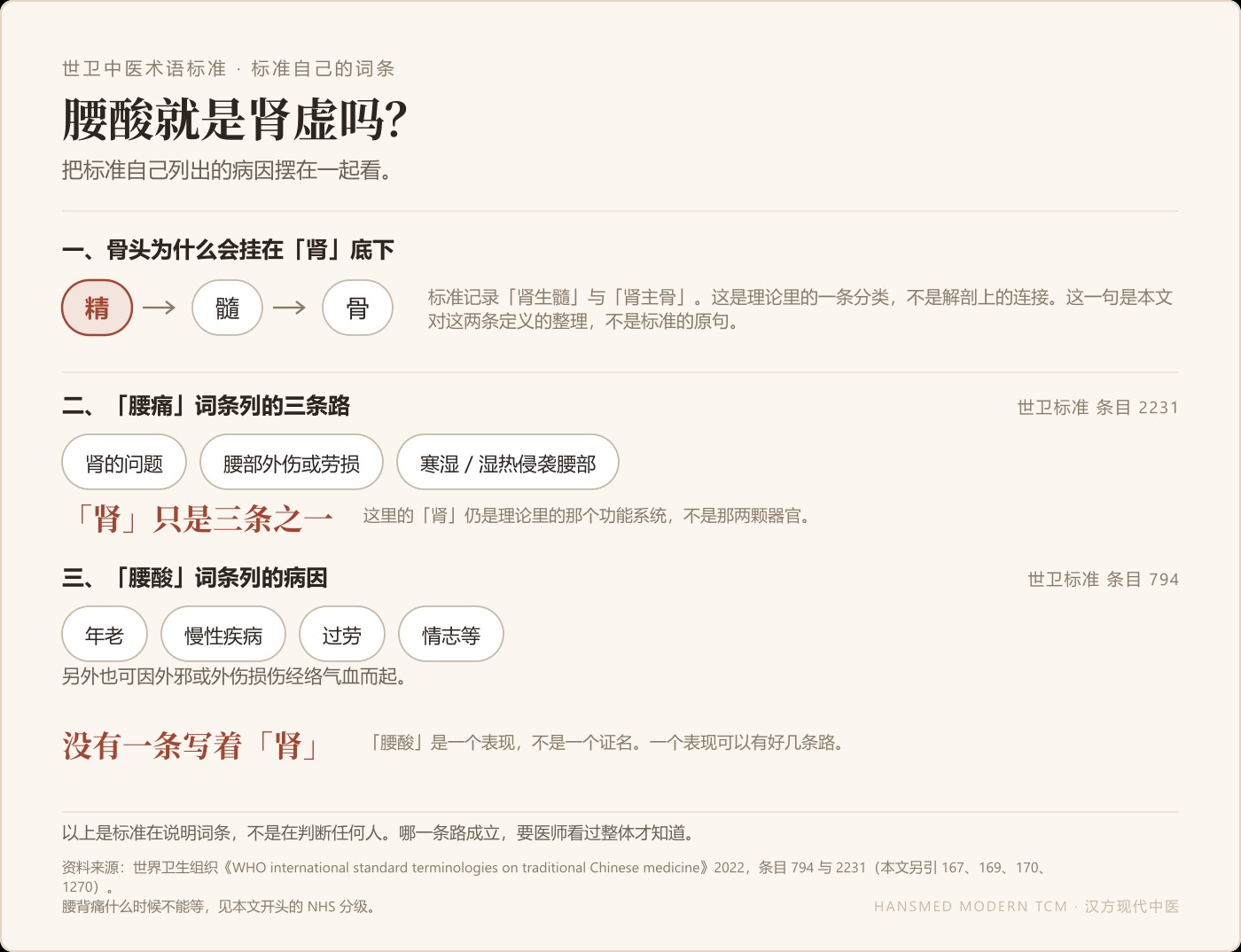
Part 2 of 4 in the kidney series. Part 1 is what the TCM "kidney" governs and what "kidney deficiency" means; part 3 is the blood test and the tonic packet; part 4 is when to see a doctor and what a consultation does.
"Three months of overtime, my back aching the whole time, and a friend says that's kidney deficiency." A common line — and it skips every other route the theory itself lists.
This part answers one question: why the lower back and the bones get counted under the "kidney", and how that relates to the organs on a report.
The short version
- Bones sit under the "kidney" because of two entries in the WHO's TCM terminology standard: the kidney generates marrow, and the kidney governs the bones. The direction is essence → marrow → bone.
- The often-heard 「腰为肾之府」 comes from a classical text and is not an entry in the standard; this article does not use it as a definition.
- The standard's own "lower back pain" entry lists three routes: kidney problems, trauma or strain, cold damp or damp heat affecting the lumbar region. The kidney is one of three.
- The "low back soreness" entry lists ageing, chronic diseases, over-exertion, emotions and the like, or damage to meridian qi and blood — and names the kidney not at all.
- The National Kidney Foundation of Malaysia says the kidneys produce a hormone that stimulates the bone marrow to make red blood cells. Both accounts use the words "bone" and "marrow". That is not evidence.
First, the things that cannot wait
Persistent flank pain, particularly with fever — call 999 now, or go to the nearest hospital emergency department. The NHS's kidney infection page lists a high temperature and pain in the lower back or side among its symptoms.
Back pain with any of the following — pain, tingling, weakness or numbness in both legs; loss of feeling around the genitals or anus; changes in bladder or bowels, such as difficulty peeing or incontinence; chest pain; or pain that started after a serious accident: call 999 now, or go to the nearest hospital emergency department. Those are the NHS back pain page's 999-tier items.
Severe pain that starts suddenly, or is getting worse quickly — see a doctor urgently, the same day. That is the NHS back pain page's tier too.
The urine and swelling situations, with the reason each is checked, are in part 4. TCM and Western medicine complement each other; it is not a choice between them.
A note: this section is general information only. For conditions like these, follow your doctor's diagnosis and treatment, and seek medical attention when you need it.
I. Essence → marrow → bone: why bones sit under the "kidney"
Part 1 set out the six things the TCM "kidney" governs. Of them, "bones" stops people: what have the kidneys to do with the skeleton.
The answer is in two of the WHO standard's entries. It records the kidney generates marrow (肾生髓): kidney essence transforms into and generates bone marrow. And the kidney governs the bones (肾主骨): kidney essence generates marrow to nourish bones.
The direction is exactly that: essence → marrow → bone. Bones sit under 「肾」 not because the anatomical kidney is attached to the skeleton, but because the theory assigns the essence that nourishes bone to the kidney. That sentence is this article's integration of the two definitions, not the standard's own words.
Everything starts at "essence" — which is how things that look unconnected end up strung along one word.
💡 Remember: this chain is a classification inside the theory, not an anatomical connection.
II. So why does an aching back get pinned on the "kidney"
The often-heard 「腰为肾之府」 is quoted, in a column from the School of Chinese Medicine at The Chinese University of Hong Kong, from the Huangdi Neijing (《黄帝内经》) as 「腰者肾之府」. It comes from a classical text; it is not an entry in the WHO standard, and this article does not use it as a definition. What connects the lower back to the kidney in the standard is its symptom entries themselves.
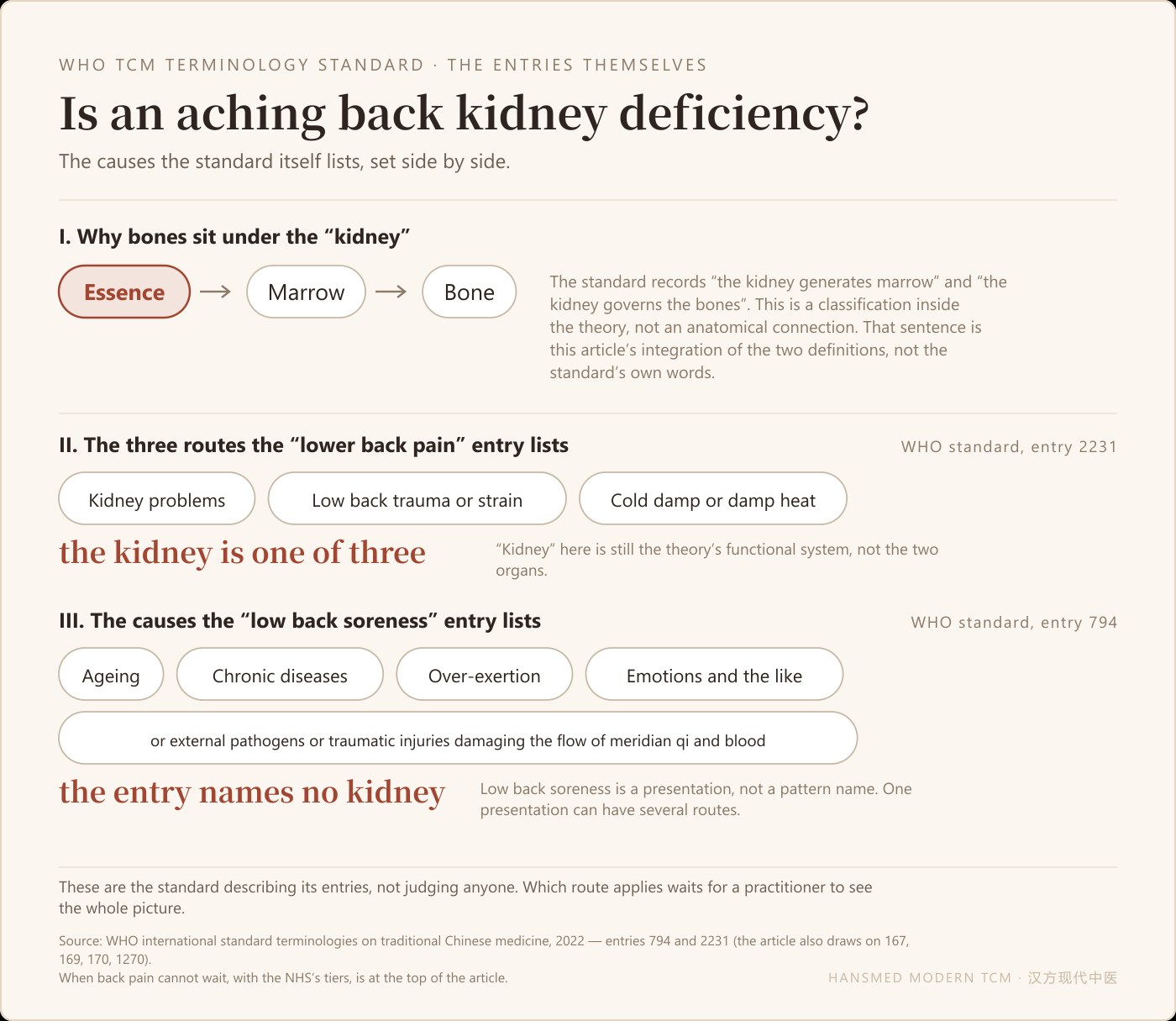
"Lower back pain" (腰痛) is described in the standard as pain on one or both sides of the lumbar vertebrae, which often results from kidney problems, low back trauma or strain, or cold damp or damp heat affecting the lumbar region — and "kidney" here is still the theory's functional system, not the two organs.
The "low back soreness" (腰酸) entry says it often results from ageing, chronic diseases, over-exertion, emotions and the like; alternatively, it may also occur when external pathogens or traumatic injuries damage the flow of meridian qi and blood.
Side by side it is clear: even inside the theory, lower back pain has several routes and the kidney is one of three, while the low back soreness entry's routes name the kidney not at all. What "an aching back means kidney deficiency" skips is exactly those other routes.
The same goes for "you've got kidney deficiency" in crunch season. The standard's description of 「肾虚证」 does contain the words "postnatal over-exertion" — but that is the standard describing the pattern, not judging you. Which route applies, and whether it is that pattern, both wait for a practitioner to see the whole picture.
One line from the other side belongs here: back pain often improves on its own within a few weeks — stay active, continue with daily activities, and do not stay in bed for long periods. That is the NHS's back pain page. What cannot wait is at the top of this article.
💡 Remember: one presentation can have several routes. An aching back is a presentation, not a pattern name.
III. The organ on the report, set beside it
With the theory set out, look at the organ — not to confirm one from the other, but to see they talk about different things.
The National Kidney Foundation of Malaysia describes them this way: they filter 180 litres of fluid a day to produce 2 litres of urine; remove harmful wastes from the body via urine; and keep the body's internal environment constant.
The same page says the kidneys produce certain hormones: erythropoietin, which stimulates the bone marrow to produce red blood cells, and renin, which regulates blood pressure; and they activate vitamin D, which helps maintain calcium balance in the bones.
Both accounts use the words "bone" and "marrow". That is not evidence. One is a functional category inside a theory, the other a physiological description of an organ. This article does not use either to prove the other, and does not translate between them.
So 「肾虚」 and kidney disease are two different claims. They are two different languages, and one does not "turn into" the other. 「肾虚证」 is a pattern name in TCM theory, reached by a practitioner after seeing the whole picture. Whether the kidney as an organ is diseased is established by a urine test for protein and a blood test for creatinine — the National Kidney Foundation's checkup items — and judged by a doctor. One claim holding in the theory does not mean the other holds in the laboratory, and the reverse is equally true. What those tests measure is part 3.
A note: this section is general information only. For conditions like these, follow your doctor's diagnosis and treatment, and seek medical attention when you need it.
The words in this part
The first four come from the WHO's TCM terminology standard, the last from the National Kidney Foundation of Malaysia.
- The kidney generates marrow (肾生髓) — kidney essence transforms into and generates bone marrow.
- The kidney governs the bones (肾主骨) — kidney essence generates marrow to nourish bones. Filing bone under the "kidney" is the classification the theory makes from it.
- Lower back pain (腰痛), a symptom entry — pain on one or both sides of the lumbar vertebrae, often resulting from kidney problems, trauma or strain, or cold damp or damp heat affecting the lumbar region.
- Low back soreness (腰酸), a symptom entry — often results from ageing, chronic diseases, over-exertion, emotions and the like; may also occur when external pathogens or traumatic injuries damage meridian qi and blood.
- Erythropoietin (促红细胞生成素) — a hormone the kidneys produce, stimulating the bone marrow to make red blood cells. You may meet it on a haematology or renal information page.
The other three parts
- Part 1: What "kidney deficiency" actually means — what the TCM "kidney" governs
- Part 3: What a blood test measures, and how to read a "kidney tonic" packet
- Part 4: When to see a doctor first, and what the practitioner does at a consultation
👉 If you are not sure "how to set out this aching back for a practitioner", you are welcome to book an online consultation with HansMed, where a practitioner registered under the T&CM Act 2016 can assess it with you; if anything in "First, the things that cannot wait" above or in part 4 applies, see a doctor first.
Sit with a licensed TCM practitioner from wherever you are.
HansMed Modern TCM
For general wellness education only — not medical advice. Consult a registered TCM practitioner for personal guidance.
Sources
- World Health Organization, WHO international standard terminologies on traditional Chinese medicine, 2022 — https://www.who.int/publications/i/item/9789240042322
- School of Chinese Medicine, The Chinese University of Hong Kong, Sky Post column, Zhang Hongwei, PhD, "How to walk for fitness?", 9 January 2020 — https://www.scm.cuhk.edu.hk/zh-tw/news-and-literature/articles/articles-skypost-list/1597-2020-01-09/
- National Kidney Foundation of Malaysia, Facts About Kidneys — https://nkf.org.my/facts-about-kidneys/
- National Kidney Foundation of Malaysia, Common Kidney Disease — https://nkf.org.my/facts-about-kidneys/common-kidney-disease/
- NHS, Back pain, page last reviewed 05 March 2026 — https://www.nhs.uk/conditions/back-pain/
- NHS, Kidney infection, page last reviewed 13 February 2025 — https://www.nhs.uk/conditions/kidney-infection/