Part 4 of 6 in the allergic rhinitis series. Part 1 is what allergic rhinitis is and what histamine does; part 2 is how TCM reads the nose; part 3 is the measures at home; part 5 is when to see a doctor first; part 6 is what an online consultation does.
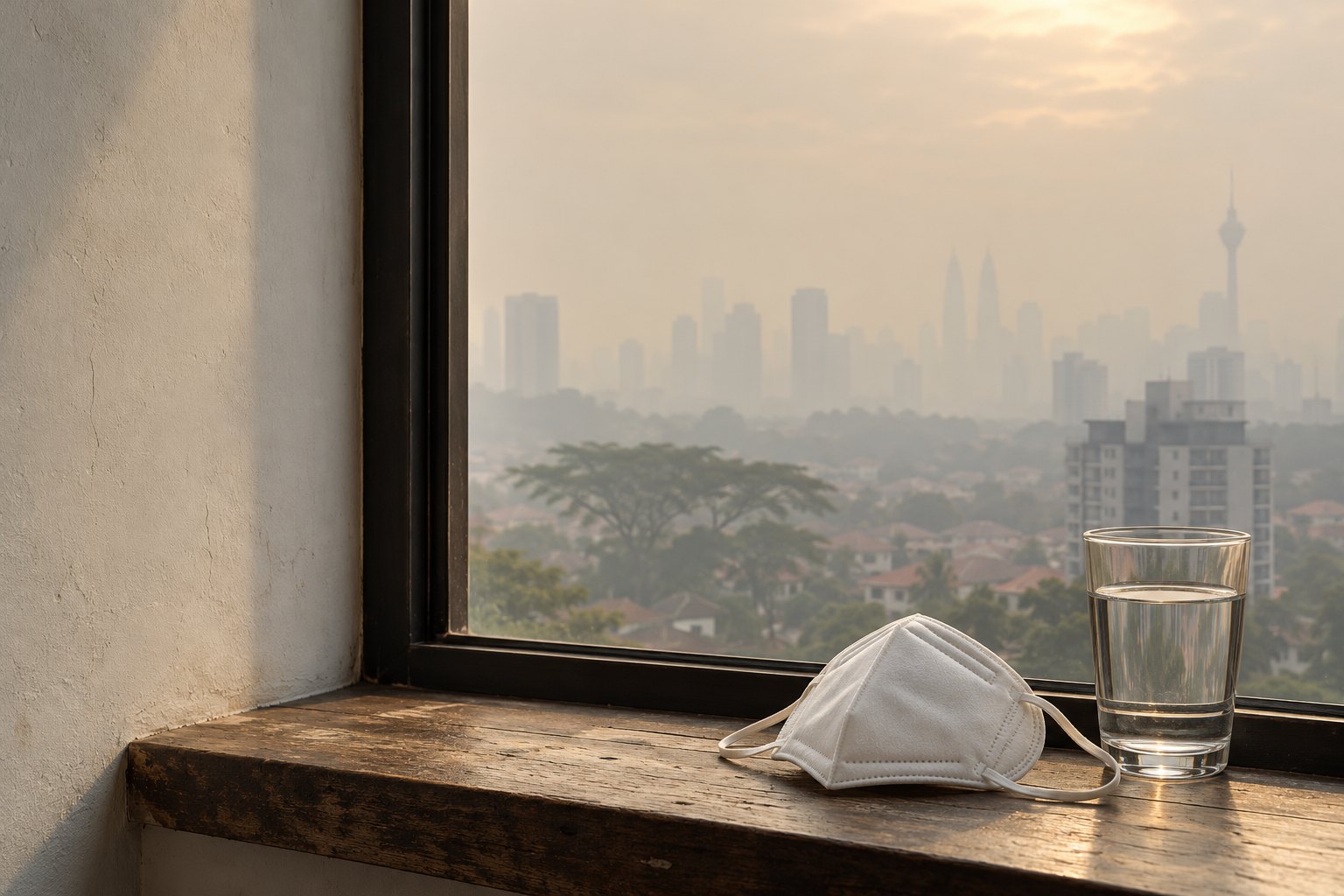
Malaysia has no four seasons, but two things are here all year: air-conditioned rooms, and haze season. Part 3 was the house; this part is after you leave it.
The short version
- "It blocks the moment I walk into an air-conditioned room" has a place in Western medicine too: the NHS lists very hot or cold temperatures and humidity among the causes of non-allergic rhinitis.
- On haze days, start with the API. It is the highest of the pollutants' sub-indices, each with its own averaging period — that is the DOE's method.
- The MOH says the high-risk group wears a mask outdoors at 101 to 200 and everyone does at 201 to 300; people with health problems see a doctor at 201 to 300.
- For the mask, a respirator such as an N95 — the MOH states the particles of haze may be as small as 2.5 microns and a surgical mask will not stop them. An N95 is not suitable for pregnant women or children.
- Over-the-counter decongestant sprays go no longer than 5 days at a time, the NHS's cap; say what you bought and for how long at the consultation.
First, the things that cannot wait
Difficulty breathing, wheezing, speaking in short phrases, or blue lips — call 999 now, or go to the nearest hospital emergency department.
A nosebleed lasting longer than 10 to 15 minutes, or bleeding that seems excessive — the NHS nosebleed page puts this one in A&E. Call 999 now, or go to the nearest hospital emergency department.
Persistent one-sided blockage, repeated nosebleeds, or blood-streaked discharge — have a doctor establish the cause first; do not treat it as allergic rhinitis yourself. The full list is in part 5.
⚠️ A safety note: TCM and Western medicine complement each other; it is not a choice between them. If you are under medical treatment, TCM care is a layer added on top — not a layer swapped in.
A note: this section is general information only. For conditions like these, follow your doctor's diagnosis and treatment, and seek medical attention when you need it.
I. The air-conditioned room, and the car
"It blocks the moment I walk in" has its place in Western medicine. The NHS non-allergic rhinitis page lists changes in the weather — temperature or humidity — among the common causes, and its allergic rhinitis page puts very hot or cold temperatures and humidity in that non-allergic box, a different thing from allergic rhinitis. Which box it is, is a doctor's call, not a matter of matching symptoms to a list. If you are not sure what is causing it, the NHS says see a doctor.
The theory's direction is simple: vent away from your face, a thin jacket at the desk. The entry behind it is "The lung dislikes cold" — the World Health Organization's TCM terminology standard states the lung is intolerant of cold and its qi is easily damaged by exogenous pathogenic cold; the theory holds that a cold draught on the nose and mouth chills lung qi first. Those two measures are drawn from "The lung dislikes cold"; no page sets them out. That is the theory's language, not a diagnosis of you.
Driving in haze: the MOH says aircon on recirculation, windows closed.
II. Haze days: start with the number
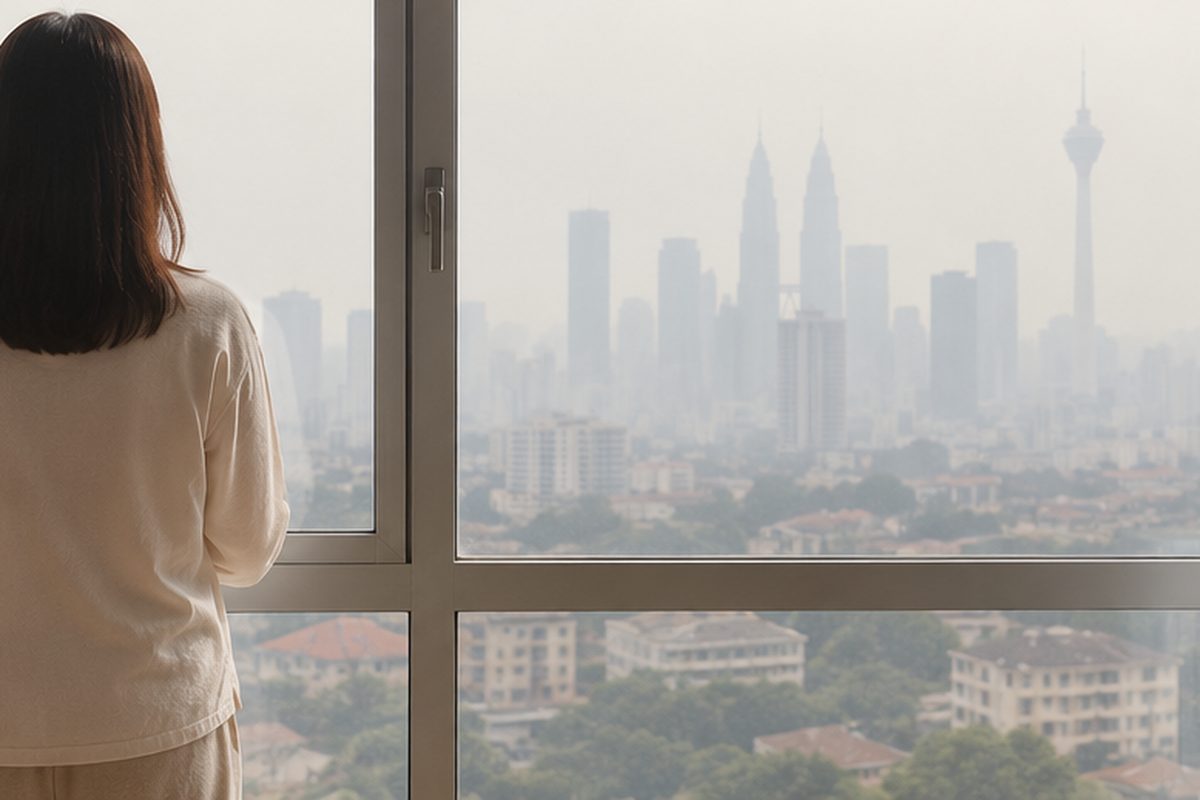
Malaysia's air-quality reading is the API, the Air Pollutant Index. The DOE's bands are 0 to 50 Good, 51 to 100 Moderate, 101 to 200 Unhealthy, 201 to 300 Very Unhealthy, above 300 Hazardous.
Where the number comes from. The DOE's calculation document states that the highest relative sub-index is taken as the API reading — the dashboard lists six pollutants: PM2.5, PM10, sulphur dioxide, nitrogen dioxide, ozone and carbon monoxide. Each has its own averaging period: 24 hours for PM10 and PM2.5, 8 hours and 1 hour for ozone, 1 hour for sulphur dioxide and nitrogen dioxide, and 8 hours for carbon monoxide; the dashboard's note adds that the API is calculated on a 24-hour running average of the most dominant parameter — so it is not a score for "average air", but whichever pollutant is worst right now, speaking.
What to do at each band. The MOH's practice: at 101 to 200 the high-risk group limits outdoor activity and wears a mask outdoors, while everyone else reduces vigorous outdoor activity; at 201 to 300 everyone avoids vigorous outdoor activity and wears a mask outdoors, the high-risk group stays indoors and reduces physical activity, and people with health problems see a doctor.
The same page also says: stay indoors as far as you can, drink plenty of water, wash your face and exposed skin often. Older people, pregnant women and children are all on the MOH's high-risk list.
💡 Remember: the API is an action threshold, not a footnote to the weather forecast — 101 and 201 each trigger their own set of measures.
III. The mask: why a respirator
The MOH's mask page states that the particles causing haze "may be as small as 2.5 microns", that "The use of the surgical mask will not prevent one from inhaling the small airborne particles", and that "Therefore the recommended protection is the use of the respirator."
Respirators work better than surgical masks because they seal better, "restrict more polluted air from entering the nose and mouth" and carry the right filter for fine particles. The N95 is one; the MOH states it "may be used as protection during the haze" — but it "is effective only if used correctly", and fit testing is needed.
Three things the MOH sets down specifically:
- An N95 "is not suitable for pregnant women and children."
- The MOH states that wearing an N95 increases the effort of breathing, and lists discomfort breathing, tiredness and headache. If it is uncomfortable, the MOH says stop and consult a doctor.
- The MOH states that facial hair can affect the seal, and that long hair may also get between the seal and the face — coming between the face and the respirator's edge, it can let contaminated air leak in.
Commuting by motorbike. Wind straight at the nose and mouth is a thing the theory minds — visor down and neck covered is the theory's direction. And if you have taken the type of antihistamine that makes you feel sleepy, the NHS says do not drive or use machinery — so do not ride either.
IV. The pharmacy shelf
Allergic rhinitis can often be handled without seeing a GP, says the NHS — a pharmacist is where to start. Which step each class is aimed at is in part 1.
Two things to remember when you buy:
- Over-the-counter decongestant sprays go no longer than 5 days at a time — using them too long can make the blocked nose worse, says the NHS.
- Do not use more than one medicine for a blocked nose at the same time, including two sprays together or a spray plus tablets. Also the NHS.
A spray or medicine your doctor prescribed is used as the doctor directed — never stop your medication on your own. If pharmacy treatments are not working, the NHS says see a doctor.
Say what you bought and for how long you used it at the consultation — how to keep the notes is in part 6.
⚠️ A note: this section is about who to ask before you buy, not about how to use anything. Which one, how long, whether it suits you: ask a pharmacist or a doctor.
The words in this part
- Non-allergic rhinitis (非过敏性鼻炎) — a different thing from allergic rhinitis, states the NHS, with common causes including changes in the weather such as temperature or humidity.
- API, Air Pollutant Index (空气污染指数) — the DOE's reading, the highest of the pollutants' sub-indices; the MOH's advice goes by its bands.
- Fine particles, PM2.5 (细颗粒) — very small airborne particles; the MOH states the particles causing haze may be as small as 2.5 microns.
- Respirator (呼吸器) — the MOH's term, set against the surgical mask: it seals better and carries a filter for fine particles; an N95 is one.
Frequently asked
What about air-conditioned rooms? The theory's direction is the vent away from your face, a thin jacket, a warm drink on the desk; the Western account, why telling the two apart is the doctor's job, and when to see a doctor are all in section I above. Difficulty breathing or wheezing means call 999 now, or go to the nearest hospital emergency department.
The other five parts
- Part 1: How allergic rhinitis happens, and what histamine does
- Part 2: How TCM reads the nose, and the "surface"
- Part 3: At home: bedding, dust, rinsing the nose
- Part 5: When to see a doctor first
- Part 6: What an online consultation does
👉 If you are not sure how to arrange air-conditioned rooms and haze days around your kind of nose, you are welcome to book an online consultation with HansMed, where a practitioner registered under the T&CM Act 2016 can assess it with you; if anything in "First, the things that cannot wait" above or in part 5 applies, see a doctor first.
Sit with a licensed TCM practitioner from wherever you are.
HansMed Modern TCM
For general wellness education only — not medical advice. Consult a registered TCM practitioner for personal guidance.
Sources
- NHS, Allergic rhinitis, page last reviewed 08 January 2026 — https://www.nhs.uk/conditions/allergic-rhinitis/
- NHS, Non-allergic rhinitis, page last reviewed 04 March 2026 — https://www.nhs.uk/conditions/non-allergic-rhinitis/
- NHS, Antihistamines, page last reviewed 16 May 2023 — https://www.nhs.uk/medicines/antihistamines/
- NHS, Decongestants, page last reviewed 03 November 2022 — https://www.nhs.uk/medicines/decongestants/
- NHS, Nosebleed, page last reviewed 05 December 2023 — https://www.nhs.uk/conditions/nosebleed/
- Kementerian Kesihatan Malaysia, Langkah-Langkah Pencegahan Semasa Jerebu, last updated 29 September 2025 — https://www.moh.gov.my/teras/info-kesihatan/jerebu/artikel-dan-panduan-pengguna-berkaitan-jerebu/langkah-langkah-pencegahan-semasa-jerebu
- Kementerian Kesihatan Malaysia, Usage Of Personal Protection During Haze, last updated 29 September 2025 — https://www.moh.gov.my/teras/info-kesihatan/jerebu/artikel-dan-panduan-pengguna-berkaitan-jerebu/usage-of-personal-protection-during-haze
- Department of Environment Malaysia, Air Pollutant Index Management System (APIMS) — https://eqms.doe.gov.my/APIMS/main · Air Pollutant Index Calculation: https://eqms.doe.gov.my/Documents/APIMS/API_Calculation.pdf
- World Health Organization, WHO international standard terminologies on traditional Chinese medicine, 2022 — https://www.who.int/publications/i/item/9789240042322