Part 6 of 6 in the "Stress, sleep and TCM theory" series. The list of the other five is at the foot of this part.
Part 1 said that 「肝气郁结」 and 「心神不宁」 belong after a consultation. This part is about what that "after" looks like: the order it runs in, and what to bring.
Once the situations in part 5 are ruled out, this is how stress and poor sleep are handled in a TCM consultation.
The short version
- The order is routine first, then the pattern, then the direction. Reverse it and you have the mistake in the forwarded graphic.
- The practitioner first asks when you sleep and wake, whether you moved during the day, when the last coffee or tea was, what you do before bed. All of this is far more useful than "stressed".
- Then what you are taking: prescribed medication, over-the-counter products from a pharmacy, a supplement marketed as "calming" that a relative gave you. Doing this safely depends on both sides knowing.
- A direction may include acupuncture, herbal medicine or routine adjustments, decided between you and the practitioner at the consultation. This article does not say "what the effect will be", because that belongs to an individual assessment.
A note: this section is general information only. For conditions like these, follow your doctor's diagnosis and treatment, and seek medical attention when you need it.
First, the things that cannot wait
⚠️ A safety note: TCM and Western medicine complement each other; it is not a choice between them. Difficulties with mood and sleep have a layer that needs professional assessment, and a TCM consultation does not substitute for that assessment. Asking for help is not weakness — there is professional support for this.
Thoughts of harming yourself — this is not something to wait on. Call 999 now, or go to the nearest hospital emergency department. To talk to someone, the Ministry of Health's Talian HEAL 15555 is open every day from 8 am to 12 midnight, public holidays included; Befrienders KL is open 24 hours on 03-7627 2929. You can also contact your doctor.
All seven items, and why each one means seeing a doctor first, are in part 5.
A note: this section is general information only. For conditions like these, follow your doctor's diagnosis and treatment, and seek medical attention when you need it.
I. The order: routine first, then the pattern, then the direction
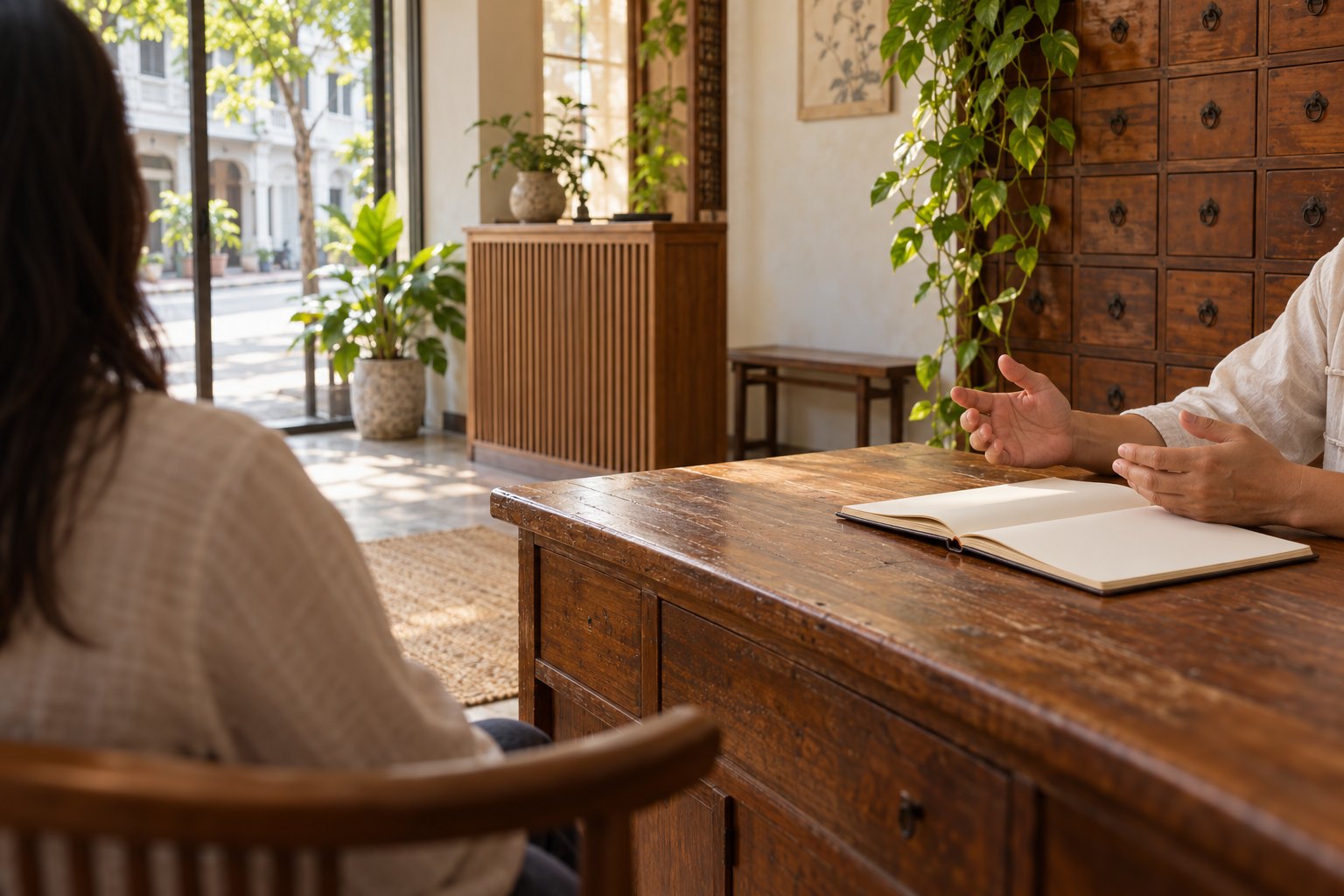
- Routine first, pattern later. The practitioner asks when you sleep and wake, whether you moved during the day, when the last coffee or tea was, what you do before bed, and whether this is crunch season or exam season. All of this is far more useful than "stressed".
- What you are taking. Prescribed medication, over-the-counter products from a pharmacy, a supplement marketed as "calming" that a relative gave you. Doing this safely depends on both sides knowing.
- Assessment. Only after seeing the whole picture does the practitioner say whether this is 「肝气郁结」, 「心神不宁」, or another pattern. That step comes after the consultation, not before it.
- Then a direction, not a promise. The options a practitioner may raise include acupuncture, herbal medicine, and the kind of routine adjustments in part 4. Which suits you, and whether to use any, is decided between you and the practitioner at the consultation.
- This article does not say "what the effect will be", because that belongs to an individual assessment, not to an article.
- Already seeing a doctor or a counsellor. Say so. A TCM consultation runs alongside counselling and psychiatric care; it does not replace either. Never stop medication your doctor prescribed because you have started TCM care.
Why the order runs that way: the WHO standard writes the liver qi stagnation pattern and the disquieted heart spirit pattern as the names of patterns. A pattern is the output of a judgement, not an input to it — that sentence is this article's reading of the usage, not the standard's own words. The routine, the medication and the whole picture come first; only then is there anything to judge.
On what a sleep consultation actually asks, see that part of the sister series: what is asked about the sleep itself and the daytime. On how assessment works: what pattern differentiation is.
Remember: routine first, then the pattern, then the direction. Reverse that order and you have the mistake in the forwarded graphic.
A note: this section is general information only. For conditions like these, follow your doctor's diagnosis and treatment, and seek medical attention when you need it.
II. What to bring
These are the things that save the most time at a consultation:
- A list of your routine: the last week or two of sleep and waking times, whether you moved during the day, the time of the last coffee or tea, what you do before bed. Written down beats recalled.
- Everything you are taking: medication your doctor prescribed (the original packaging is clearest), over-the-counter products from a pharmacy, a supplement marketed as "calming" that a relative gave you, health products from a direct-sales friend — describe the contents and where they came from, and show them at the consultation.
- The "liver qi self-test" graphic a friend forwarded: a good starting point for a question, not a conclusion. Bring the screenshot and discuss it at the consultation.
- Already seeing a doctor at a Klinik Kesihatan or a private clinic, or seeing a counsellor: say so, including any medication.
That last item is not a courtesy. A TCM consultation runs alongside a doctor's diagnosis and treatment, and it is only safe when both sides know what you are using.
💡 Remember: the objects and the times you bring are more use than the adjectives. "Stressed" gives a practitioner very little to work with; a routine list gives a lot.
The words used in this part
- Inquiry (问诊) — the asking part of a consultation: the routine, the medication and the whole picture. It comes before the assessment.
- Pattern differentiation (辨证) — the step where the practitioner reaches a judgement after seeing the whole picture. 「肝气郁结」 and 「心神不宁」 are both terms from after that step; the definitions are in part 1.
- Over-the-counter (OTC) — medicine you can buy at a pharmacy without a prescription. It still needs declaring, because it is still something you are taking.
- Direction — the word this article uses instead of "course of treatment" or "result": what the practitioner raises is a set of options, the decision happens in the consultation, and the effect belongs to an individual assessment.
Frequently asked
Are the online "liver qi self-tests" accurate? They do not hold up. The same set of presentations can point to different patterns in TCM theory, which is exactly why a practitioner's assessment exists. Bring the graphic to the consultation as a question; do not use it to reach a conclusion.
What does a TCM consultation actually do about stress and poor sleep? It asks about routine and what you are taking, then assesses, and only then raises a direction — acupuncture, herbal medicine or routine adjustments — decided with the practitioner at the consultation. Section I above is the full order.
I already take medication my doctor prescribed. Can I still see a TCM practitioner? Yes, but both sides need to know. Say what you are taking at the start of the consultation, and never stop it or adjust it on your own because you have started TCM care. A TCM consultation runs alongside counselling and psychiatric care; it does not replace either.
Can an online consultation do all this? The routine, the medication and the whole picture can all be asked online. If anything listed in part 5 applies, see a doctor first — online or in person, that does not change.
✅ Worth remembering: 「肝气郁结」 and 「心神不宁」 are a practitioner's terms after assessment, reached after a consultation — not self-labels.
A note: this section is general information only. For conditions like these, follow your doctor's diagnosis and treatment, and seek medical attention when you need it.
The other five parts in this series
- Part 1: What 「肝气」 and 「心神」 mean — two definitions, and what they are not
- Part 2: What "liver qi" models — one concept, three threads
- Part 3: The two languages side by side, and one crunch-season week
- Part 4: What TCM theory arranges day to day — six habits in one table
- Part 5: See a doctor first in these situations — seven signs, and the reason for each
👉 If you are not sure where to begin with your own stress and poor sleep, you are welcome to book an online consultation with HansMed, where a practitioner registered under the T&CM Act 2016 can assess it with you; if anything in part 5 applies, see a doctor first.
Sit with a licensed TCM practitioner from wherever you are.
HansMed Modern TCM
For general wellness education only — not medical advice. Consult a registered TCM practitioner for personal guidance.
Sources
- World Health Organization, WHO international standard terminologies on traditional Chinese medicine, 2022 (entries 1161 · 1240) — https://www.who.int/publications/i/item/9789240042322
- Ministry of Health Malaysia, Hospital Pendang (Kedah State Health Department), Info Kesihatan 2024 (the Talian HEAL 15555 number and its hours) — https://jknkedah.moh.gov.my/hpendang/index.php?option=com_sppagebuilder&view=page&id=139
- Befrienders Kuala Lumpur (the 24-hour line) — https://www.befrienders.org.my/