Part 3 of 4 in the desk-work neck and shoulder series. Part 1 is why sitting still aches; part 2 is the desk and the breaks; part 4 is when to see a doctor first.
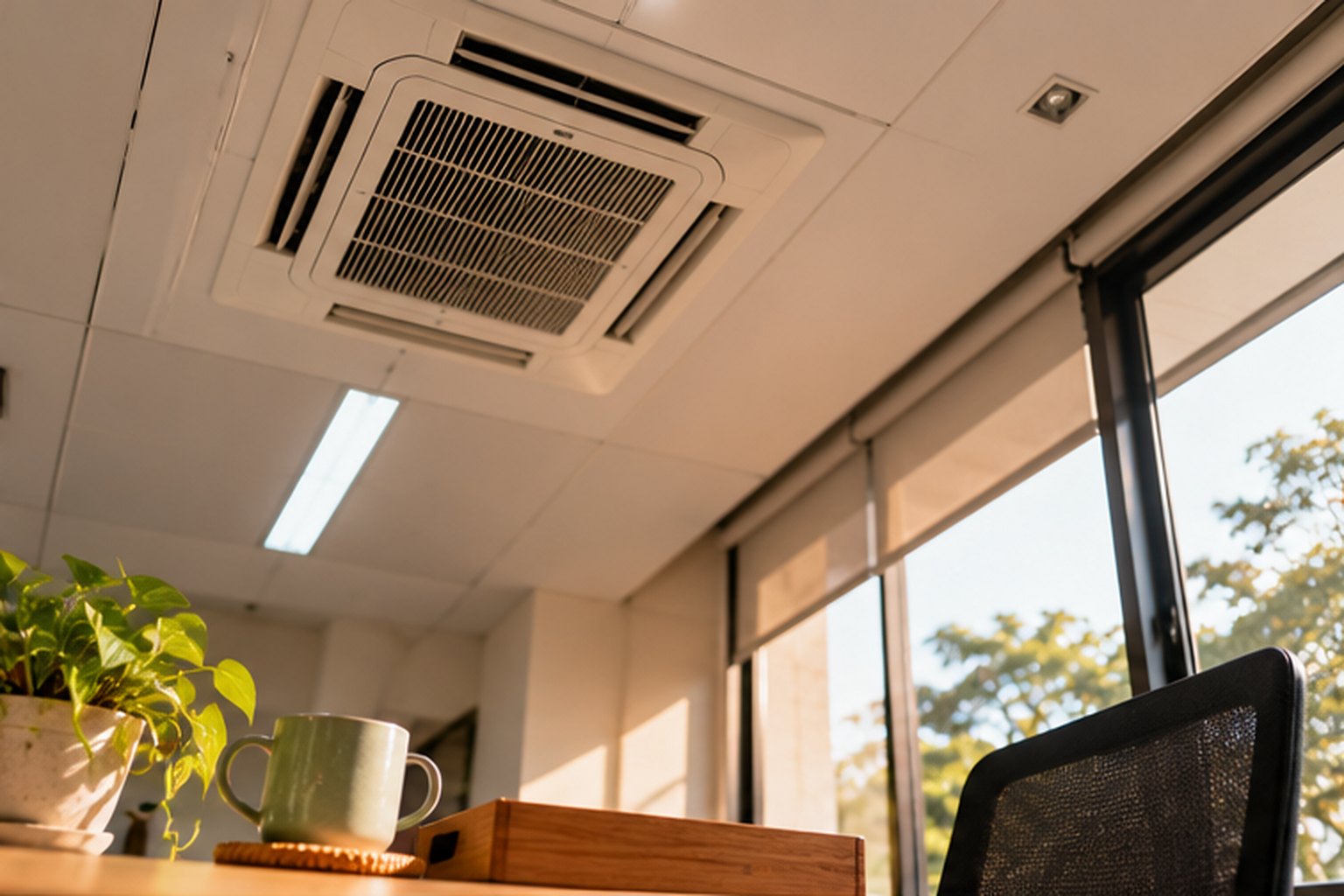
"My seat is right under the vent and it blows on the back of my neck all day — has that got anything to do with the aching?" In Malaysia it comes up more often than the weather does.
This part does one thing: it puts the two accounts of cold air on the neck side by side, then the everyday Malaysian arrangements. Part 1 was about "long"; this one is about "cold".
The short version
- In Malaysia the common form of "cold on the shoulder" is not winter but an office vent aimed at the neck, or the car air-conditioning on full.
- TCM theory's side: a registered practitioner at CUHK's School of Chinese Medicine summarises the cause of 漏肩风 as wind, cold and damp obstructing qi and blood so the channels stop flowing freely and pain results — hence keep warm, keep the shoulder out of the cold.
- The WHO's 2022 international standard terminologies on TCM writes the line out entry by entry: pathogenic wind opens the skin pores and is highly mobile; pathogenic cold is characterised by coldness, stagnation, congealing and contraction; "cold congeals and stagnates" causes pain, and "cold causes contraction" causes contractions.
- DOSH's language is different: cold temperature leads to reduced sensory feedback and tensed-up muscle as the body constricts blood vessels to prevent heat loss.
- Both accounts use a word for "contracting", but they are two models — not presented here as one and the same thing.
First, the things that cannot wait
Chest pain that feels tight or squeezing, or chest pain spreading to your arms, neck or jaw — call 999 now, or go to the nearest hospital emergency department. The NHS heart attack page states a heart attack happens when blood flow to the heart is blocked, and lists both chest pains among its reasons to call 999. This is an emergency, not a consultation booking.
Persistent numbness or weakness in the arm or fingers — get urgent help. The NHS lists "pins and needles that do not go away" and "no feeling in your arm or shoulder" among the reasons to get urgent help.
The full list is in part 4.
A note: this section is general information only. For conditions like these, follow your doctor's diagnosis and treatment, and seek medical attention when you need it.
I. Cold air from the vent: how TCM theory puts it
A registered practitioner at the Chinese University of Hong Kong's School of Chinese Medicine summarises the cause of "漏肩风" (lou jian feng, a classical TCM disease name for one kind of shoulder pain) this way: wind, cold and damp enter the sinews, bones and joints directly, qi and blood are obstructed, the channels stop flowing freely, and pain results; so daily life should emphasise keeping warm and keeping the shoulder out of the cold. That is the column's subject, not a diagnosis of any reader.
The terminology standard writes this line out entry by entry. The WHO's 2022 international standard terminologies on TCM defines "pathogenic wind" as a pathogenic factor characterised by opening the skin pores, high mobility and upward and outward movement; wind flows upward and easily affects the head, the face, the surface of the body and the yang meridians; and wind is the spearhead of the exogenous pathogenic factors, liable to associate itself with cold, dampness, dryness and heat — which is why the theory says "wind" and "cold" in one breath. "Pathogenic cold" is a pathogenic factor characterised by coldness, stagnation, congealing and contraction; "cold congeals and stagnates" is pathogenic cold causing qi and blood to stagnate, blocking the meridians and causing pain; "cold causes contraction" is pathogenic cold constricting qi, blocking the skin pores and causing contractions.
Joining these entries (the linking here is this article's own): wind opens the pores first and cold follows; cold stops qi and blood moving and tightens the area; when the channels do not flow freely, there is pain. That is the standard's entry-by-entry counterpart to the CUHK column's sentence "qi and blood are obstructed by them, the channels stop flowing freely, and pain results", and the theory behind its direction "keep warm and keep the shoulder out of the cold".
💡 Remember: the above is the language the TCM framework uses. It explains how the theory reads "catching cold"; it is not a diagnosis of you.
II. How DOSH puts the same thing
DOSH also speaks of cold, in another language: cold temperature leads to reduced sensory feedback and tensed-up muscle, with less dexterity and flexibility, as the body constricts blood vessels to prevent heat loss. That sits among its environmental risk factors, alongside posture and screens.
Both accounts use a word for "contracting" — DOSH of muscle and blood vessels, the standard of qi and pores — but they are two models, and this article does not present them as one. They share only where they land, and that is plain: if your seat is under the vent, add a light jacket or redirect it. If your neck and shoulders already ache, the side the air-conditioning hits is worth mentioning at the consultation.
⚠️ A safety note: TCM and Western medicine complement each other; it is not a choice between them. Separating "the ache I always have" from "numbness or weakness that is new" matters — the second is neither a posture nor a cold problem, and part 4 covers it.
III. Fitting it into life in Malaysia
- Working from home at the dining table. Dining-table height is fixed. DOSH's approach to a fixed-height table is a keyboard tray, or raising the chair; if your feet then leave the floor, add a footrest.
- Sitting under the office air-conditioning vent. Keep a light jacket on the chair, or redirect the vent.
- Commuting by motorbike. A long held position in traffic plus vibration is a separate load from the office chair — describe them separately.
- Standing on the LRT, laptop in the car. DOSH advises minimising laptop use on public transport and in vehicles.
- Napping face-down on the desk at lunch. Common, and worth a mention at the consultation.
- Catching up on exercise at weekends. Nothing all week and a heavy weekend is itself information.
On the neck and shoulders specifically: stiff, aching neck and shoulders. If you are unsure where your situation should go: when an online consultation is not the right choice.
💡 Remember: these are everyday arrangements, not treatment. Which applies to you is for the practitioner to judge at a consultation.
The words in this part
- Pathogenic wind (风邪) — a WHO-standard entry among the causes of illness: a factor characterised by opening the skin pores, high mobility and upward and outward movement.
- Pathogenic cold (寒邪) — from the same group: a factor characterised by coldness, stagnation, congealing and contraction.
- Cold congeals and stagnates (寒性凝滞) — pathogenic cold causes qi and blood to stagnate, blocks the meridians, and causes pain.
- Cold causes contraction (寒性收引) — pathogenic cold constricts qi, blocks the skin pores, and causes contractions.
- 漏肩风 (lòu jiān fēng) — a classical TCM disease name for one kind of shoulder pain, and the subject of the CUHK column quoted above; not a diagnosis of any reader.
- Qi and blood (气血) — the theory's own category, not the blood in the vessels; the full account is in part 1.
Frequently asked
How high should my pillow be? The NHS neck-pain page gives no number of centimetres, only a direction: use a low, firm pillow; when sleeping, make sure your head is the same height as the rest of your body; do not sleep on your front, and do not twist your neck in bed. So the answer to "how high" goes as far as the guideline does: low and firm, head level with the body. If the ache is still there a few weeks after changing the pillow, bring that to the consultation.
Is a fan better than air-conditioning? This article has no page it can cite comparing a fan with air-conditioning, so it does not make that comparison. Both accounts point the same way: do not leave the neck and shoulders in a draught for long stretches, and put a layer on when it is cold.
The other three parts
- Part 1: Why desk work makes the neck and shoulders ache
- Part 2: Screen height and how often to stand up
- Part 4: When to see a doctor first
👉 If you are not sure "the side the air-conditioning hits keeps aching — where does this go next", you are welcome to bring it to an online consultation with HansMed, where a practitioner registered under the T&CM Act 2016 can assess it; if anything in "First, the things that cannot wait" above or in part 4 applies, see a doctor first. In-person consultations are coming soon.
Sit with a licensed TCM practitioner from wherever you are.
HansMed Modern TCM
For general wellness education only — not medical advice. Consult a registered TCM practitioner for personal guidance.
Sources
- Department of Occupational Safety and Health Malaysia, Guidelines on Occupational Safety and Health for Seating at Work 2024 — https://dosh.gov.my/wp-content/uploads/2025/12/On-Occupational-Safety-And-Health-For-Seating-At-Work-2024-kecik.pdf
- Department of Occupational Safety and Health Malaysia, Guidelines on Occupational Safety and Health for Working with Display Screen Equipment 2024 — https://dosh.gov.my/wp-content/uploads/2025/01/GUIDELINES-ON-OSH-FOR-DSE_Full_21Nov.pdf
- NHS, Neck pain, page last reviewed 27 April 2023 — https://www.nhs.uk/symptoms/neck-pain-and-stiff-neck/
- NHS, Shoulder pain, page last reviewed 22 May 2023 — https://www.nhs.uk/symptoms/shoulder-pain/
- NHS, Heart attack, page last reviewed 31 March 2026 — https://www.nhs.uk/conditions/heart-attack/
- Chinese University of Hong Kong, School of Chinese Medicine, "A note on 漏肩风", Ngan Kit (registered TCM practitioner), Sky Post column 16 November 2017 — https://www.scm.cuhk.edu.hk/zh-tw/news-and-literature/articles/articles-skypost-list/295-2017-11-16/
- World Health Organization, WHO international standard terminologies on traditional Chinese medicine, Geneva 2022 — https://www.who.int/publications/i/item/9789240042322