
Part 2 of 4 in the desk-work neck and shoulder series. Part 1 is why sitting still aches; part 3 is the air-conditioning; part 4 is when to see a doctor first.
"How high should the screen be, and how often should I get up?" They are questions that come up often, and both have a public standard to check against.
This part does one thing: it sets out what Malaysia's Department of Occupational Safety and Health (DOSH) states about the desk and the breaks. What follows is the occupational-safety guideline's standard, not treatment advice; its use is checking your own desk against.
The short version
- The screen: DOSH puts the monitor directly in front of you, at arm's length (45 cm to 70 cm), its top usable line at a height where the neck is straight.
- Elbows and feet: for typing, DOSH puts the work surface about 30 to 50 mm below sitting elbow height, shoulders relaxed rather than shrugged, and the chair set so the thighs are parallel to the ground and both feet flat.
- How often to get up: DOSH's case studies recommend a one-minute standing break after 30 minutes of sitting; a registered practitioner at CUHK's School of Chinese Medicine recommends changing position at least every 45 minutes — the two numbers are close.
- Screen breaks: DOSH's 20/20/20 — every 20 minutes, look at something at least 20 feet away, for at least 20 seconds; the guideline states the purpose is to change the focus of the eyes.
- "Moving" here means a habit, not an exercise; movements aimed at the neck or lower back are taught by a professional who has examined you.
First, the things that cannot wait
Chest pain that feels tight or squeezing, or chest pain spreading to your arms, neck or jaw — call 999 now, or go to the nearest hospital emergency department. The NHS heart attack page states a heart attack happens when blood flow to the heart is blocked, and lists both chest pains among its reasons to call 999. This is an emergency, not a consultation booking.
Persistent numbness or weakness in the arm or fingers — get urgent help. The NHS lists "pins and needles that do not go away" and "no feeling in your arm or shoulder" among the reasons to get urgent help.
The full list is in part 4.
A note: this section is general information only. For conditions like these, follow your doctor's diagnosis and treatment, and seek medical attention when you need it.
I. DOSH's workstation standards: screen, elbows, feet
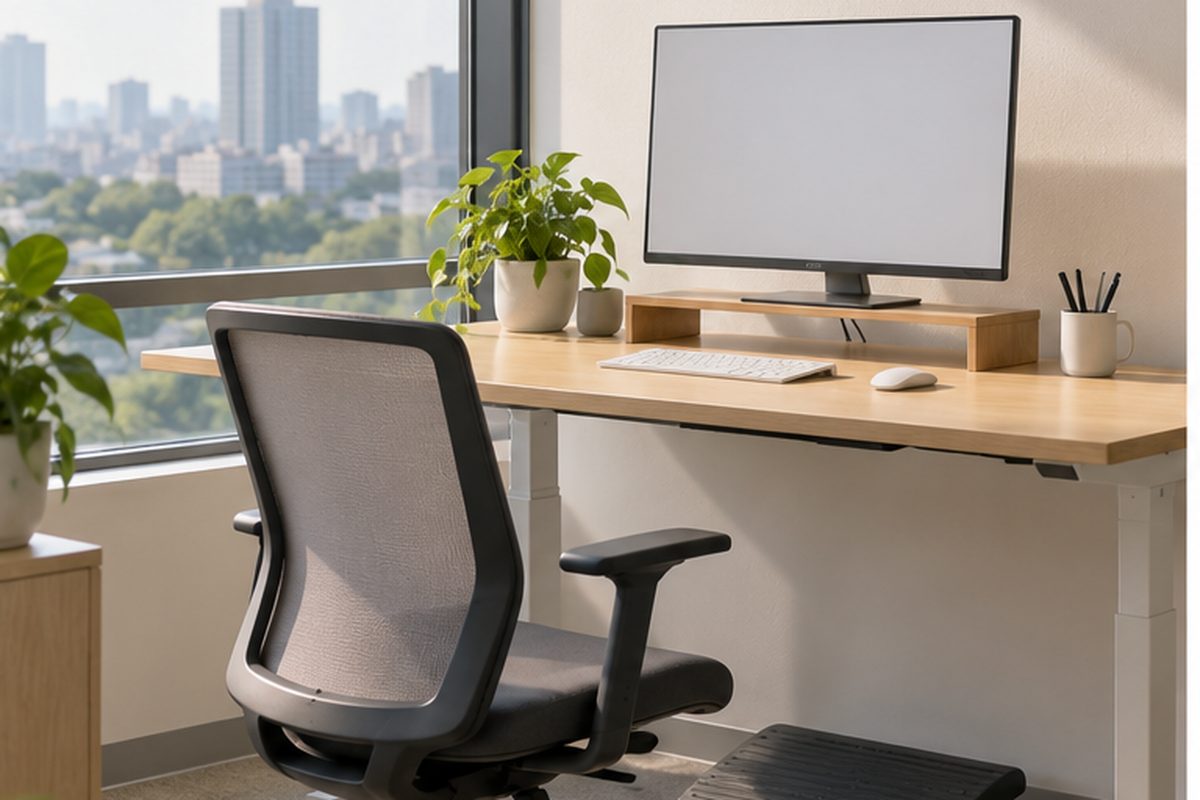
- Screen: DOSH's steps are to place the monitor directly in front of you, at arm's length (45 cm to 70 cm), with its top usable line at a height where the neck is straight — at eye height for single-prescription glasses or contacts, below eye height for bifocal, trifocal or progressive lenses.
- Laptops: DOSH notes a laptop's built-in screen is typically lower than eye level; for prolonged use, an external keyboard, mouse and monitor should be provided.
- Elbows and desk: DOSH states that a seated worker normally prefers both hands at roughly elbow level or slightly lower, and that for typing the work surface should be about 30 to 50 mm below sitting elbow height, so the fingers type at around elbow height with the shoulders relaxed, not hunched or shrugged. In DOSH's own case illustration, the improved position has the hand at a 90-degree angle and the shoulder relaxed.
- Feet: DOSH's step is to adjust the chair so the thighs are parallel to the ground with both feet flat on the floor. A chair set too high presses on the thighs, and DOSH writes the footrest down as a last resort, for when the chair cannot be lowered.
- What a screen set too high or too low does: DOSH's risk table files it under "awkward posture", whose potential symptoms include neck pain and shoulder pain.
💡 Remember: these numbers are DOSH's standards for employers and employees. Wherever your desk does not match is information worth giving at the consultation.
II. How often to get up: one table

The table below sets the two public accounts side by side. The registered practitioner at the Chinese University of Hong Kong's School of Chinese Medicine gives this reason: holding one posture for a long time has an adverse effect on the joints of the cervical spine, and when the body stays still for long the neck and shoulder muscles and ligaments must work harder to hold the posture, their blood supply also restricted by the lack of movement.
| Situation | What the public guidance says | Usual practice | When to see a doctor first |
|---|---|---|---|
| Sitting continuously | DOSH's case studies: a one-minute standing break after 30 minutes of sitting. CUHK's School of Chinese Medicine: change position at least every 45 minutes | Stand to take calls, walk to the pantry for water | Shoulder pain not improving after two weeks, neck pain not going away after a few weeks: see a doctor (part 4) |
| Staring at the screen | DOSH lists "keeping the head still while looking at the monitor" as an example of a static posture; its 20/20/20: every 20 minutes, look at something at least 20 feet away, for at least 20 seconds; the guideline states the purpose: to change the focus of the eyes, allowing the muscles in the eyes to rest from the otherwise constant focus | Look away, to the window or the end of the corridor | Pins and needles that do not go away, or no feeling in the arm or shoulder: get urgent help (part 4) |
| Working on a laptop | Its screen is typically lower than eye level, and a monitor too high or too low sits under "awkward posture" in DOSH's risk table; for prolonged use, an external keyboard, mouse and monitor; minimise use on public transport and in vehicles | DOSH's own display-screen case study made two changes: the screen raised a little on a ream of paper, and the keyboard and mouse moved to a keyboard tray under the desk | As above |
| After work: phone on the sofa, laptop in bed | NHS: do not keep your neck in the same position for a long time. DOSH lists continuously holding a phone or tablet as a static posture | Change seat and position at the end of each episode | Night pain that wakes you and keeps worsening: see a doctor first (part 4) |
DOSH calls things like answering the telephone or a discussion "productive rest", because they change the posture and rest the muscles. As for movements aimed at the neck or lower back, do not follow online videos on your own; the NHS shoulder-pain page says it plainly: do not make up your own strenuous exercises.
⚠️ A safety note: DOSH wrote "change position, stand up and move around" into the guideline; exercise instruction comes from a professional who has examined you. TCM and Western medicine complement each other, it is not a choice between them, and separating "the ache I always have" from "numbness or weakness that is new" matters — the second is not a posture problem, and part 4 covers it.
The words in this part
- Static posture (静态姿势) — DOSH's term: one posture held with almost no movement for a long period. The full definition is in part 1.
- Awkward posture (不良姿势) — a group in DOSH's risk table; a monitor set too high or too low is filed here.
- 20/20/20 — DOSH's break rule for screen work: every 20 minutes, look at something at least 20 feet away, for at least 20 seconds.
- Productive rest (有产出的休息) — DOSH's term for work that changes the posture and rests the muscles, such as answering telephones or a discussion.
Frequently asked
Is a standing desk useful? DOSH's position is not "standing beats sitting" but "change". The Seating at Work guidelines: sitting for long periods can lead to discomfort and may result in long-term health problems, so employees need the opportunity to change position, stand up and move around; the short breaks it describes include switching from seated work to standing work. The Standing at Work guidelines say: standing is a natural human posture and by itself poses no particular health hazard, but prolonged standing at work can lead to ergonomic risk factors that affect health. Where a standing desk fits is a matter of those two sentences.
The other three parts
- Part 1: Why desk work makes the neck and shoulders ache
- Part 3: What air-conditioning on the neck and shoulders does
- Part 4: When to see a doctor first
👉 If you are not sure "the desk is set up as advised and my neck and shoulders still ache — where does this go next", you are welcome to bring it to an online consultation with HansMed, where a practitioner registered under the T&CM Act 2016 can assess it; if anything in "First, the things that cannot wait" above or in part 4 applies, see a doctor first. In-person consultations are coming soon.
Sit with a licensed TCM practitioner from wherever you are.
HansMed Modern TCM
For general wellness education only — not medical advice. Consult a registered TCM practitioner for personal guidance.
Sources
- Department of Occupational Safety and Health Malaysia, Guidelines on Occupational Safety and Health for Seating at Work 2024 — https://dosh.gov.my/wp-content/uploads/2025/12/On-Occupational-Safety-And-Health-For-Seating-At-Work-2024-kecik.pdf
- Department of Occupational Safety and Health Malaysia, Guidelines on Occupational Safety and Health for Working with Display Screen Equipment 2024 — https://dosh.gov.my/wp-content/uploads/2025/01/GUIDELINES-ON-OSH-FOR-DSE_Full_21Nov.pdf
- Department of Occupational Safety and Health Malaysia, Guidelines on Occupational Safety and Health for Standing at Work 2024 — https://dosh.gov.my/wp-content/uploads/2025/01/GUIDELINES-ON-OCCUPATIONAL-SAFETY-AND-HEALTH-FOR-STANDING-AT-WORK-2024.pdf
- NHS, Neck pain, page last reviewed 27 April 2023 — https://www.nhs.uk/symptoms/neck-pain-and-stiff-neck/
- NHS, Shoulder pain, page last reviewed 22 May 2023 — https://www.nhs.uk/symptoms/shoulder-pain/
- NHS, Heart attack, page last reviewed 31 March 2026 — https://www.nhs.uk/conditions/heart-attack/
- Chinese University of Hong Kong, School of Chinese Medicine, "Baduanjin for neck and shoulder pain", Chung Kiu Lam (registered TCM practitioner), Sky Post column 1 December 2016 — https://www.scm.cuhk.edu.hk/zh-tw/news-and-literature/articles/articles-skypost-list/333-2016-12-01/