Part 3 of 6 in the "Chinese herbs and Western medication" series. All six are listed at the foot.
This is a question many people search for, and the answer has two layers: a number, and the limit of that number.
The short version
- As a general rule, Chinese and Western medicines are taken at least one to two hours apart — that is what Hong Kong's Hospital Authority writes, and China Medical University's Institute of Integrated Chinese and Western Medicine says the same.
- In the same paragraph the Authority continues: this only avoids interactions caused by direct contact in the stomach, and cannot avoid potential interactions once the medicines have been absorbed.
- Spacing solves "swallowed together", not "in the body together". It reaches station ① absorption from part 2; ② to ⑥ — distribution, metabolism, excretion, additive, antagonistic — it does not reach.
- Two more routes lie outside its reach: ⑤ additive (both sides pushing the same way) and ⑥ antagonistic (pushing opposite ways). These two are the pharmacodynamic half from part 1.
- The Authority's own two teaching examples are exactly these: 麻黄汤 with added paracetamol, and far too much sweating; and liquorice taken long-term in larger doses, weakening the effect of blood-pressure medication.
- The simplest arrangement: leave your Western medication where it is and place the herbs at least one to two hours away. If your practitioner gives a different gap, follow the written instruction.
First, the one thing never to do
⚠️ A safety note: TCM and Western medicine complement each other. It is not a choice between them. This part names Western drug classes. Whichever one you recognise, never stop on your own — do not stop, reduce or adjust any prescribed Western medication because you read this, since changes to a prescription are decided by the doctor who wrote it.
The full account is in part 1.
A note: this section is general information only. For conditions like these, follow your doctor's diagnosis and treatment, and seek medical attention when you need it.
I. How far apart: usually at least one to two hours
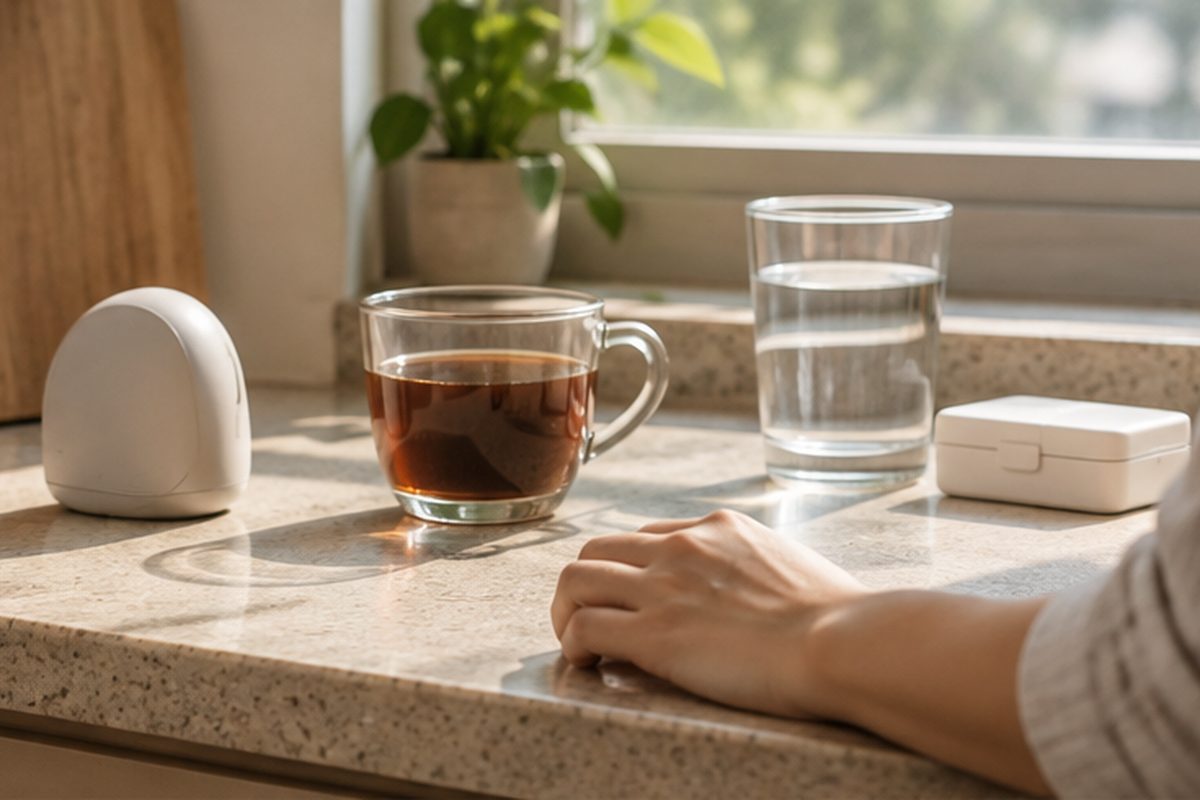
First layer, the number. As a general rule, Chinese and Western medicines are taken at least one to two hours apart — that is what the Hospital Authority writes. China Medical University's Institute of Integrated Chinese and Western Medicine says the same: a one-to-two-hour gap may reduce some of the absorption interference caused by both being in the gut at once.
Second layer, the limit of the number. In the same paragraph the Hospital Authority continues: this only avoids interactions caused by direct contact in the stomach, and cannot avoid potential interactions once the medicines have been absorbed. Spacing solves "swallowed together", not "in the body together".
The Hospital Authority's Smart Patient lecture material says the same: the gap of at least one to two hours is there to avoid interactions caused by direct contact in the gut. Set against part 2: spacing addresses station ① absorption; ② to ⑥ happen after the medicine is in the body, where spacing does not reach.
- The simplest arrangement: keep your Western medication at its usual time and place the herbs at least one to two hours away from it. For example, Western medication with breakfast, herbs two hours after that.
- If both are taken several times a day, write the day's timetable down and show it at the consultation.
- If your practitioner gives a different gap for a specific prescription, follow the written instruction. It fits your situation more closely than the general rule.
⚠️ A safety note: spacing is one tool, not a guarantee. The real safeguard is both practitioners knowing what you take.
II. The two routes a gap does not reach: ⑤ additive, ⑥ antagonistic
Part 2's four stations are about how the body handles a medicine. The two remaining routes run the other way: what two medicines do to the body, either stacked together or cancelling each other out. This is the pharmacodynamic half from part 1.
⑤ Additive: both sides push the same way. The Hospital Authority's teaching example: a patient has fever, chills, a runny nose, aching head and body, and a wheezing cough without sweating; the TCM diagnosis is wind-cold common cold, the treatment principle is to induce sweating and release the exterior, and the prescription is 麻黄汤 (Ephedra Decoction).
The patient adds paracetamol on their own, sweats far too much and develops 虚脱 (collapse). Two sweat-inducing actions stacked, and it went too far. That is "additive".
Notice which step went wrong in that example: not the prescription, but adding something on your own. Neither side knew what the other was doing.
⑥ Antagonistic: the two sides push opposite ways. Constituents of 甘草 (liquorice) have a steroid-hormone-like action; taken long-term in larger doses, liquorice can reduce urine output, so water is retained in the body, blood pressure rises, and the effect of blood-pressure medication is weakened. That account is the Hospital Authority's too.
The Hospital Authority labels liquorice "tonifies the spleen and qi, harmonises the other herbs". It is common in prescriptions; dose and duration are the practitioner's to manage, which presumes the practitioner knows you take blood-pressure medication.
Both of these routes happen after the medicine is already inside the body. Which is precisely where "two hours apart" does not reach.
A note: this section is general information only. For conditions like these, follow your doctor's diagnosis and treatment, and seek medical attention when you need it.
III. These are examples, not a list
These are the Hospital Authority's examples, not a list where anything unlisted is safe. One herb can appear under several routes (黄连, 甘草 and 山楂 all do), which is why the judgement is made on your whole medication list.
Do not stop or reduce any Western medication named in this part because you read this; take the list and the question to the prescribing doctor.
The words in this part
- Pharmacodynamics (药效学) — the Hospital Authority's gloss: what a medicine does to the body. Both ⑤ additive and ⑥ antagonistic sit here; the full account is in part 1.
- Additive (作用叠加) — the Authority's name for the fifth route: two medicines' effects on the body push the same way and add up. Its example is 麻黄汤 with paracetamol, both of which induce sweating.
- Antagonistic (作用抵消) — the name for the sixth route: the two effects push opposite ways and weaken each other. Its example is liquorice long-term in larger doses, against blood-pressure medication.
- Inducing sweating and releasing the exterior (发汗解表) — the treatment principle the Authority records in that teaching example, which is what the prescription it records was meant to do. It is written about that one case, and is not for a reader to apply to themselves.
- 虚脱 (collapse) — the Authority's word for how that example ended: far too much sweating, then 虚脱.
Frequently asked
Can I take Chinese and Western medicine at the same meal? Generally not advised. At least one to two hours apart is the usual practice, as Hong Kong's Hospital Authority writes it; if your practitioner gives a different instruction, follow it. The Hospital Authority also cautions: even with these measures, Chinese and Western medicines may still interact inside the body; in most cases the effect is mild, but you still need to watch how you feel closely and consult a healthcare professional when needed.
So would four hours, or six, be safer still? That does not follow. What the Hospital Authority gives is "at least one to two hours", and what it explains is what that gap avoids and what it does not — it does not say that stretching it reaches ② to ⑥. A longer gap is not free, either: do not rewrite your Western medication schedule yourself. If it needs adjusting, ask the prescribing doctor and your TCM practitioner.
The other five parts
- Part 1: Can you take Chinese herbs with Western medication? The answer first, and the one thing never to do
- Part 2: How it actually happens: the four stations a medicine passes in the body
- Part 4: Which Western drug classes need extra care: the two with a narrow window, plus blood-pressure and blood-glucose medication
- Part 5: Red yeast rice and statins: when the supplement contains the drug, and three more classes to mention
- Part 6: What actually happens at the consultation, and fitting it into life in Malaysia
👉 If you are on Western medication and want to know how Chinese herbs should be arranged around it, you are welcome to book an online consultation with HansMed, where a practitioner registered under the T&CM Act 2016 assesses it with your medication list in view. Make sure your doctor knows about the arrangement too; safety rests on both sides having the full picture.
Sit with a licensed TCM practitioner from wherever you are.
HansMed Modern TCM
For general wellness education only — not medical advice. Consult a registered TCM practitioner for personal guidance.
Sources
- Hospital Authority, Hong Kong, HASLink July 2024, "中西藥相互作用知多少" — https://www3.ha.org.hk/ehaslink/issue132/tc/feature-3.html
- Hospital Authority, Hong Kong, Smart Patient lecture deck, 《當中藥師遇見藥劑師——認識中西藥相互作用》, PDF created 9 July 2024 — https://www.smartpatient.ha.org.hk/smart-patient-web/useful-information/sp-series/sp-series-details/%E8%97%A5-%E5%AF%86-%E8%A7%A3%E9%8E%96%E8%AC%9B%E5%BA%A7
- Institute of Integrated Chinese and Western Medicine, China Medical University, "中藥、西藥宜間隔多少時間?", page text updated 22 July 2026 — https://dhi.cmu.edu.tw/info/index.php?option=com_content&view=article&id=63&Itemid=83