Part 5 of 6 in the "Chinese herbs and Western medication" series. All six are listed at the foot.
The 红曲 on a supplement's ingredient list and the statin behind the pharmacy counter are the same kind of thing. This part is about that, and about three more classes to state clearly at a consultation.
Part 4 took the two with a narrow therapeutic window, plus blood-pressure and blood-glucose medication. These are the remaining four.
The short version
- 红曲 red yeast rice contains lovastatin, and taken with a statin it may increase lovastatin's side effects, such as stomach upset, headache, muscle pain and abnormal liver function — that is the Hong Kong Hospital Authority's account.
- The lovastatin content of red yeast rice varies widely, which is why the Authority does not recommend using it as a medicine for high cholesterol, and says it should not be taken together with other statins.
- In one line: red yeast rice and a statin are the same kind of substance; the difference is that the tablet's dose is controlled and the rice's content is not.
- The Hospital Authority notes that registered proprietary Chinese medicines containing red yeast rice must carry a caution against using them together with statins or red-yeast-rice products, or to consult a healthcare professional before use.
- Three more classes: anti-epileptics and bronchodilators (those two rows draw on China Medical University's Institute of Integrated Chinese and Western Medicine), and medicines used in surgery and anaesthesia (from Singapore's HealthHub).
- If a supplement label says 红曲, "red yeast rice" or "Monascus", tell both sides. And never stop any medicine in the table on your own.
First, the one thing never to do
⚠️ A safety note: TCM and Western medicine complement each other. It is not a choice between them. This part names Western drug classes. Whichever one you recognise, never stop on your own — do not stop, reduce or adjust any prescribed Western medication because you read this, since changes to a prescription are decided by the doctor who wrote it.
The full account is in part 1.
I. The remaining four classes, and what you do
The herb example in the table's first row comes from the Hong Kong Hospital Authority's lecture material; the other three rows name their own source in the cell.
💡 Remember: part 4 and this part come to eight rows together. Eight rows are not all the risk there is — they are eight classes to say out loud without being asked.
A note: this section is general information only. For conditions like these, follow your doctor's diagnosis and treatment, and seek medical attention when you need it.
| Drug class | Why it needs attention | What you do |
|---|---|---|
| Cholesterol medication: statins | 红曲 red yeast rice contains lovastatin; taken together, it may increase lovastatin's side effects, such as stomach upset, headache, muscle pain and abnormal liver function — the Hospital Authority's account. The red yeast rice story is below the table. | If a supplement label says 红曲, "red yeast rice" or "Monascus", tell both sides; never stop on your own |
| Anti-epileptics (e.g. valproic acid) | In the material of China Medical University's Institute of Integrated Chinese and Western Medicine, studies record herbs markedly lowering its blood level | Add no herb or supplement before discussing with the prescribing doctor |
| Bronchodilators (e.g. aminophylline) | In the same material from China Medical University, studies record an effect on its pharmacokinetics even at a one-hour gap | Do not change your Western medication schedule; space the herbs at least one to two hours away, and tell both sides |
| Surgery and anaesthesia | Singapore's HealthHub states that some herbal or proprietary Chinese medicines may interact with anaesthetics and other medicines used during surgery | Tell the surgical team what you take before the operation; whether and when to stop is their call |
II. The red yeast rice story
In the 1970s, researchers in Japan, Europe and America screened fungi in large numbers and found statin substances in three of them, confirming a cholesterol-lowering action. In 1987 lovastatin was approved in the United States as the first statin drug. Both pieces of that history are written in the Hospital Authority's lecture material.
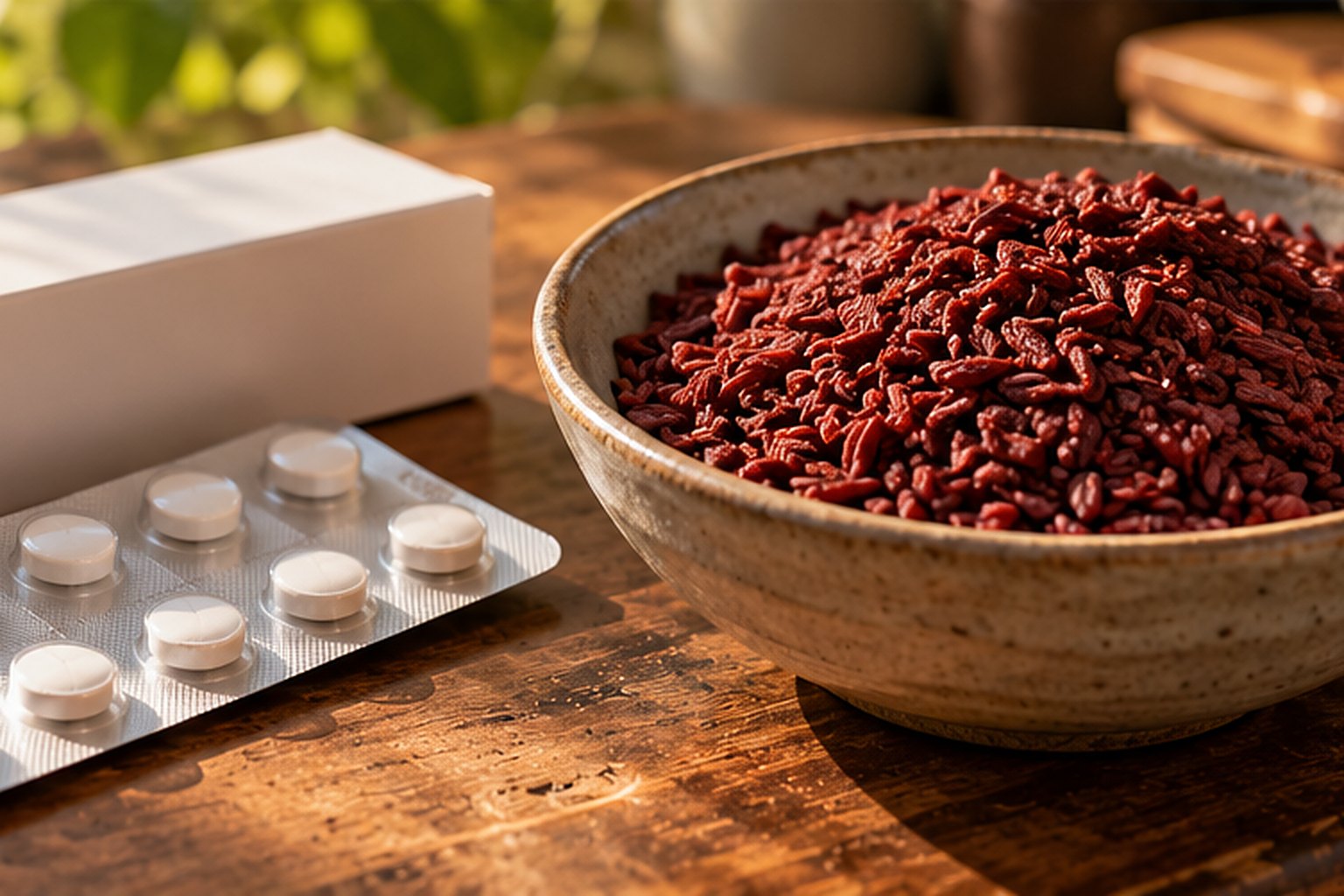
红曲, also called red yeast rice, is made by fermenting steamed rice inoculated with Monascus fungi, and has been used as food, in brewing and as a Chinese medicine for over a thousand years. Depending on the strain and the fermentation, Monascus can produce a range of substances, including pigments and lovastatin. Those two sentences come from the same material.
The sentence that matters is this one: the lovastatin content of red yeast rice varies widely, which is why the Hospital Authority does not recommend using it as a medicine for high cholesterol, and says it should not be taken together with other statins, to avoid raising the risk of adverse reactions.
The Hospital Authority also notes that registered proprietary Chinese medicines containing red yeast rice must carry the caution (in translation) "this product should not be used together with statins or products containing red yeast rice, or consult a healthcare professional before use".
In one line: red yeast rice and a statin are the same kind of substance; the difference is that the tablet's dose is controlled and the rice's content is not.
These are the Hospital Authority's examples, not a list where anything unlisted is safe. The same goes for the classes in the table: a class not listed here is not thereby cleared.
If you take several Western medications, have a chronic condition under regular review, are pregnant or breastfeeding, are a child or an older adult, or have a liver or kidney condition, give the full medication picture at the consultation.
Never stop or reduce any medicine in the table on your own.
A note: this section is general information only. For conditions like these, follow your doctor's diagnosis and treatment, and seek medical attention when you need it.
The words in this part
- 红曲 / red yeast rice — the Hospital Authority's account: made by fermenting steamed rice inoculated with Monascus fungi, used as food, in brewing and as a Chinese medicine for over a thousand years. It is what you see on a supplement's ingredient list.
- Monascus (红曲菌) — the name of that fungus. From the same material: depending on the strain and the fermentation, it can produce a range of substances, including pigments and lovastatin. Supplement labels sometimes carry this word instead.
- Lovastatin (洛伐他汀) — the history the Authority records: approved in the United States in 1987 as the first statin drug. It is in the tablet, and it is in the red yeast rice.
- Statins (他汀类) — a class of substances found in three fungi by researchers in the 1970s, with a cholesterol-lowering action confirmed. That is the origin the Authority gives.
- Bronchodilator (气管扩张药, e.g. aminophylline) — a class you will see on a box. In the material of China Medical University's Institute of Integrated Chinese and Western Medicine, studies record an effect on its pharmacokinetics even at a one-hour gap. "Pharmacokinetics" is the Hospital Authority's gloss: what the body does to a medicine, which is how it is absorbed, distributed, metabolised and cleared; the full account is in part 1.
Frequently asked
Is red yeast rice a food or a medicine? The Hospital Authority's account is that it has been used as food, in brewing and as a Chinese medicine for over a thousand years — all three. But it also points out that the lovastatin content of red yeast rice varies widely, which is why it does not recommend using red yeast rice as a medicine for high cholesterol. "It is a food" does not mean "it can be used as a drug".
Do I stop herbs before surgery? Tell the surgical team what herbs and supplements you take, and let them decide whether and when to stop — that is Singapore HealthHub's advice. Do not decide alone.
My supplement does not say 红曲, just a string of English. What then? Photograph the bottle together with its ingredient list, show it at the consultation, and mention it at your Western appointment too. The three spellings the Hospital Authority names are 红曲, "red yeast rice" and "Monascus", but labels are not limited to those three, so do not rely on reading the label yourself.
The other five parts
- Part 1: Can you take Chinese herbs with Western medication? The answer first, and the one thing never to do
- Part 2: How it actually happens: the four stations a medicine passes in the body
- Part 3: How far apart is far enough — and the two routes a gap does not reach
- Part 4: Which Western drug classes need extra care: the two with a narrow window, plus blood-pressure and blood-glucose medication
- Part 6: What actually happens at the consultation, and fitting it into life in Malaysia
👉 If you are on Western medication and want to know how Chinese herbs should be arranged around it, you are welcome to book an online consultation with HansMed, where a practitioner registered under the T&CM Act 2016 assesses it with your medication list in view. Make sure your doctor knows about the arrangement too; safety rests on both sides having the full picture.
Sit with a licensed TCM practitioner from wherever you are.
HansMed Modern TCM
For general wellness education only — not medical advice. Consult a registered TCM practitioner for personal guidance.
Sources
- Hospital Authority, Hong Kong, Smart Patient lecture deck, 《當中藥師遇見藥劑師——認識中西藥相互作用》, PDF created 9 July 2024 — https://www.smartpatient.ha.org.hk/smart-patient-web/useful-information/sp-series/sp-series-details/%E8%97%A5-%E5%AF%86-%E8%A7%A3%E9%8E%96%E8%AC%9B%E5%BA%A7
- Institute of Integrated Chinese and Western Medicine, China Medical University, "中藥、西藥宜間隔多少時間?", page text updated 22 July 2026 — https://dhi.cmu.edu.tw/info/index.php?option=com_content&view=article&id=63&Itemid=83
- HealthHub, Ministry of Health Singapore, Chinese Proprietary Medicine, page updated 24 July 2025 — https://www.healthhub.sg/well-being-and-lifestyle/personal-care/chinese_proprietary_medicine