Part 3 of 6 in the "Chinese herb risks and checkpoints" series. The list of the other five is at the foot of this part.
Part 2 ended on "registered" meaning "checked for this class". Which raises the next question: how do you tell that something is registered? And the half that matters just as much — what was never inside the number system at all.
The short version
- In Malaysia, packaged Chinese proprietary and traditional medicines must be registered with the Ministry of Health before they can be sold.
- The Ministry of Health states that a valid registration number begins with "MAL", followed by 8 digits, and ends with a letter indicating the registration category; a registered medicine must carry both the number and a Meditag hologram label on its label or packaging.
- If unsure, search NPRA's QUEST 3+ by product name or registration number; for the hologram itself, have a pharmacist check it.
- Loose herbs and a practitioner's own dispensing are exempt from registration, so they carry no MAL number — that is how the system works. Their checkpoint is sourcing and the person who composed the mix.
First, the things that cannot wait
⚠️ A safety note: TCM and Western medicine complement each other; it is not a choice between them. If you experience a severe allergic reaction (such as difficulty breathing or facial swelling) or loss of consciousness after taking herbs, call 999 now, or go to the nearest hospital emergency department.
Who needs extra care, what to do first if you feel unwell, and the reason behind each item are in part 6.
A note: this section is general information only. For conditions like these, follow your doctor's diagnosis and treatment, and seek medical attention when you need it.
I. First, what is not in the system
Where this checkpoint does not reach. Under NPRA's registration guideline, loose herbs and a practitioner's own dispensing are exempt from registration, so they do not pass through the formulation review part 2 describes. There, the checkpoint is sourcing and identification — whether the person composing the mix knows the plant.
The exemption is written into NPRA's Guideline on Registration of Natural Products: the preparations that do not require registration include an "extemporaneous preparation prepared and given directly to the patient by any traditional practitioner during the course of treatment", and a traditional preparation of natural origin "produced only through drying, without any treatment/process involved. E.g. raw herbs".
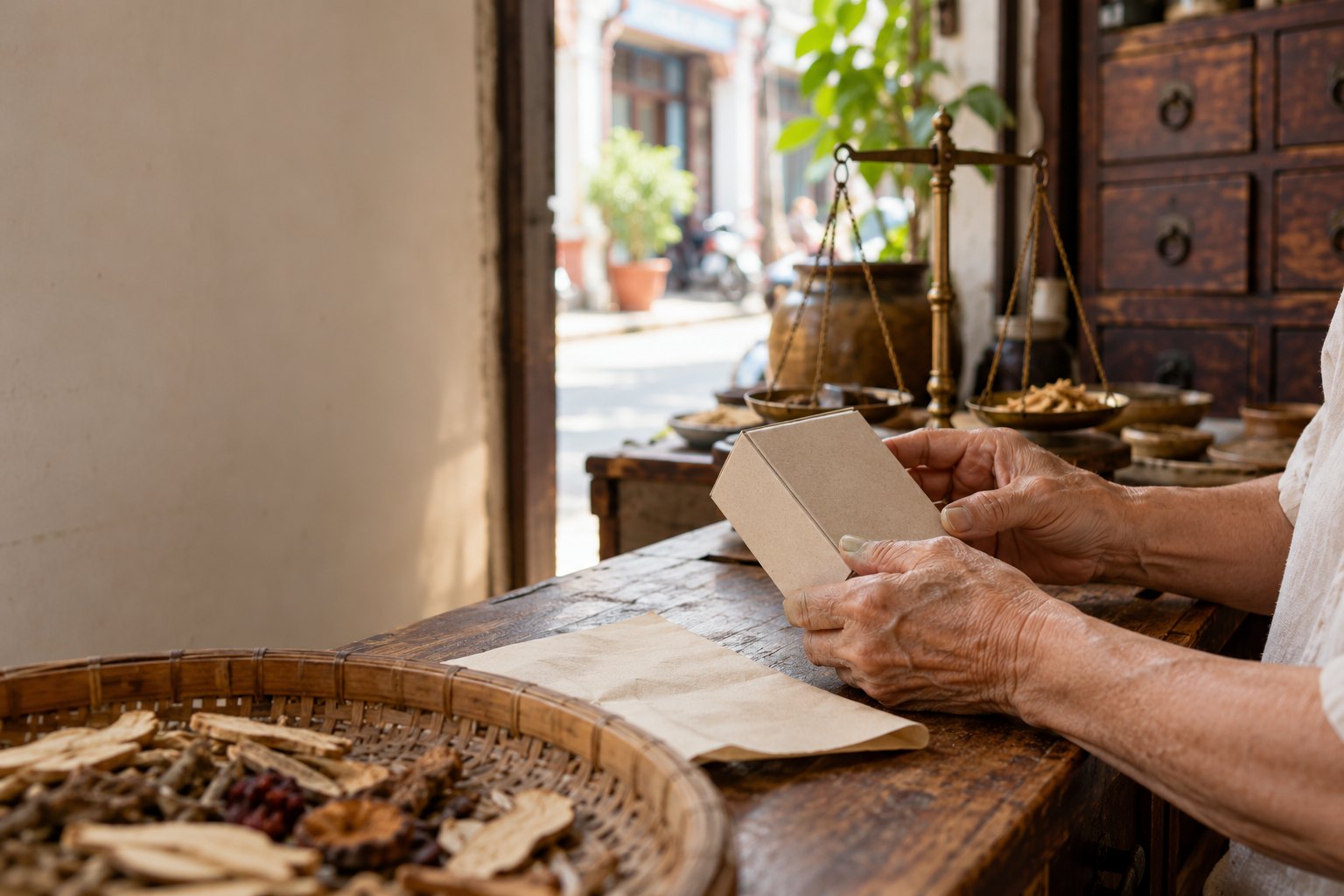
The packet a medical hall weighs out for you has no MAL number because that is how the system works — the number is a registration number, and what is not registered has none. That second half is our own reading, not the guideline's wording; what the guideline states is the exemption.
So what you are holding sorts into two kinds first: the kind with a number you can check, and the kind with no number, held by a person. The rest of this part is about the first kind.
II. Four things to look at on a packaged product
In Malaysia, packaged Chinese proprietary and traditional medicines must be registered with the Ministry of Health before they can be sold — that is the opening sentence of the Ministry's Pharmaceutical Services Programme page. The same sentence says more: all medicinal products, including imported medicines, must be registered before they can be sold or marketed to consumers. So "a friend brought it back from abroad" is not an exception to the rule; it just tells you the product has not been through the process.
Four things to look at.
- ① The MAL number. The Ministry of Health's Pharmaceutical Services Programme explains: a valid registration number begins with "MAL", followed by 8 digits, and ends with a letter indicating the registration category; registered medicines must carry both the registration number (e.g. MAL20125467T) and a Meditag hologram label on the label or packaging.
- ② The final letter T. The Ministry's category list shows "T – Natural Products/ Traditional Medicines"; Chinese proprietary medicines are generally classified under T. "Generally" is doing work in that sentence — the category list says what the letter stands for, not which products carry it.
- ③ How to check. The Ministry's page says the registration status of a product can be checked on the NPRA website by product name, registration number, holder name, active ingredient, or manufacturer/importer name; the NPRA Product Status app can be downloaded from the Google Play Store; NPRA can be called on 03-78835400; and the validity of the hologram label can be checked through a pharmacist at a nearby hospital, clinic or pharmacy. The search page is NPRA's QUEST 3+ Product Search. Its "Search By" dropdown offers six fields: Product Name, Product Registration Number, Holder Name, Manufacturer Name, Importer and Active Ingredient — so the name on the box alone is enough to search with.
- ④ On the shelf at Guardian, Watsons and other pharmacies. Turn the box over and look for the MAL number and Meditag; if you cannot find them, ask the pharmacist at the counter.
One thing to note: QUEST 3+ states on its own page that the search result displayed is only applicable on the date and time the search was conducted. So "I checked it once" is not the same as checking it today.
💡 Remember: packaged products, look for the MAL number and Meditag; loose herbs, look at the source and the person who composed the mix. Two different checkpoints. If either is missing, ask one more question.
The words in this part
All four are words you will actually meet on packaging, at a counter, or on the registration site.
- MAL registration number (MAL 编号) — the Ministry's description: a valid registration number begins with "MAL", followed by 8 digits, and ends with a letter indicating the registration category, for example MAL20125467T.
- Meditag hologram label (Meditag 防伪标签) — the anti-counterfeit label that a registered medicine must carry alongside the registration number on its label or packaging. For the hologram's validity the Ministry advises having a pharmacist check it.
- Exempt from registration (免于注册) — NPRA's own usage: certain preparations do not require registration with the Authority, including an extemporaneous preparation prepared and given directly to the patient by a traditional practitioner during treatment, and raw herbs produced only through drying.
- Extemporaneous preparation (即场配制) — the guideline's term for a preparation made up on the spot during treatment and handed straight to the patient. For that kind, dose and combination were decided for your situation, which is why it does not travel the product-registration route.
Frequently asked
How do I tell whether a product is registered? The Ministry of Health's answer is to look on the packaging for a registration number beginning with MAL, followed by 8 digits and a final letter, and for the Meditag hologram label. If unsure, search NPRA's QUEST 3+ Product Search by product name or registration number, or ask a pharmacist at a pharmacy to check the hologram for you.
What about direct-sales supplements, things brought back from overseas, and "secret family recipes" bought online? Check for a MAL number first, as in section II above. Anything with a number travels the same route as a product on the shelf; anything with no label whose contents cannot be explained, do not take — that it helped someone else does not make it composed for you. What specifically has been found in products from online and illegal sources is in the last two rows of the table in part 4.
If I cannot find it, does that mean something is wrong? Not necessarily, but do not leave it there either. What the Ministry's page says is that if the product is a registered product, the registration status will be displayed. And QUEST 3+ states that the search result displayed is only applicable on the date and time the search was conducted. So when nothing comes up, first check the name and the number for a typo, then take the two routes the Ministry suggests: have a pharmacist at a nearby hospital, clinic or pharmacy check the hologram label, or call NPRA on 03-78835400.
Do not: answer "I cannot explain where this came from" by taking a little less of it. Where the source cannot be explained, the problem is not the amount.
The other five parts
- Part 1: Do Chinese herbs carry risks? Which class has the record, and how Malaysia regulates it
- Part 2: The class with the record: what the record says, and why registration screening catches it
- Part 4: One table: what you are holding, and how to check it
- Part 5: Storing Chinese herbs — herbs and 凉茶 ingredients in a hot, humid climate, and when "too long" starts
- Part 6: Situations that need extra care — who asks a doctor and a practitioner first, and what to do if you feel unwell
👉 If you are unsure whether "this packet of herbs, or this bottle of proprietary medicine in my hand, is actually right for me to use", you are welcome to book an online consultation with HansMed, where a practitioner registered under the T&CM Act 2016 assesses it with you.
Sit with a licensed TCM practitioner from wherever you are.
HansMed Modern TCM
For general wellness education only — not medical advice. Consult a registered TCM practitioner for personal guidance.
Sources
- Ministry of Health Malaysia, Pharmaceutical Services Programme, "How to identify medicines that are registered with MOH?" — https://pharmacy.moh.gov.my/en/faq/how-identify-medicines-are-registered-moh.html
- NPRA QUEST 3+ Product Search — https://quest3plus.bpfk.gov.my/pmo2/index.php
- National Pharmaceutical Regulatory Agency (NPRA), Ministry of Health Malaysia, Drug Registration Guidance Document, Third Edition, 12th Revision July 2026, Appendix 7: Guideline on Registration of Natural Products — https://www.npra.gov.my/easyarticles/images/users/1153/drgd_appendices/APPENDIX-7-Guideline-on-Registration-of-Natural-Products.pdf