Part 5 of 6 in the "Chinese herb risks and checkpoints" series. The list of the other five is at the foot of this part.
The third of the three checks on that packet of 凉茶 ingredients in part 1 was "it has been stored properly throughout". This part is about that one: in weather like Malaysia's, what herbs are vulnerable to, and how "too long" is counted.
The short version
- Hong Kong's Chinese Medicine Regulatory Office states that damage by rodents, insects or micro-organisms, and temperature, humidity and sunlight, all affect the quality of herbs.
- The same guidance gives three reasons why humidity is the key one: mould, the herb's own enzymes hydrolysing its glycosides so their content falls, and volatile oils changing over time.
- The article states only that the content falls; "it may look fine" is our own reading — so "it looks all right" is not a check.
- There is no single number of days for "too long". If you cannot say when a packet was bought, treat it as too long; mould, insect damage or an off-smell means the whole packet goes.
First, the things that cannot wait
⚠️ A safety note: TCM and Western medicine complement each other; it is not a choice between them. If you experience a severe allergic reaction (such as difficulty breathing or facial swelling) or loss of consciousness after taking herbs, call 999 now, or go to the nearest hospital emergency department.
Who needs extra care, what to do first if you feel unwell, and the reason behind each item are in part 6.
A note: this section is general information only. For conditions like these, follow your doctor's diagnosis and treatment, and seek medical attention when you need it.
I. Why humidity is the key
Hong Kong's Chinese Medicine Regulatory Office explains: damage by rodents, insects or micro-organisms, and temperature, humidity and sunlight, all affect the quality of herbs.
The same article continues: in general, processed herbs should be stored in a cool, dry place, for example honey-fried herbs should be refrigerated to prevent mould; aromatic herbs contain volatile oils and should not be stored for long; and in general, herbs that have been stored too long should not be used.
Three reasons, all in that one article.
First, mould: micro-organisms are on its list of damaging factors, and its example is that honey-fried herbs should be refrigerated to prevent mould.
Second, the herb's own enzymes. The article states that herbs containing glycosides also contain an enzyme able to hydrolyse those glycosides, and that under a certain humidity and temperature the enzyme breaks the glycoside constituents down, lowering their content. In plain terms: a packet that has taken in moisture may look fine on the outside, yet its constituents may already be reduced — the "may look fine" is our phrasing; what the article states is that the content falls.
Third, volatile oils. Aromatic herbs contain volatile aromatic oils and should not be stored for long. Time changes what is in a herb: the article's example is 陈皮 (aged tangerine peel), where after a period of storage the volatile-oil content falls and the hesperidin, which the article names as chiefly responsible for its effect, rises in relative terms, which is why earlier generations held that 陈皮 should be used aged; but in general, herbs stored too long should not be used.
💡 Remember: what humidity damages may not be the look of a herb but its constituents. So storage is not something the eye can sign off.
II. Bringing those sentences into a Malaysian home
The five rules below are our practice, not the Hong Kong article's wording — the article gives principles, and this is how they land in this weather.
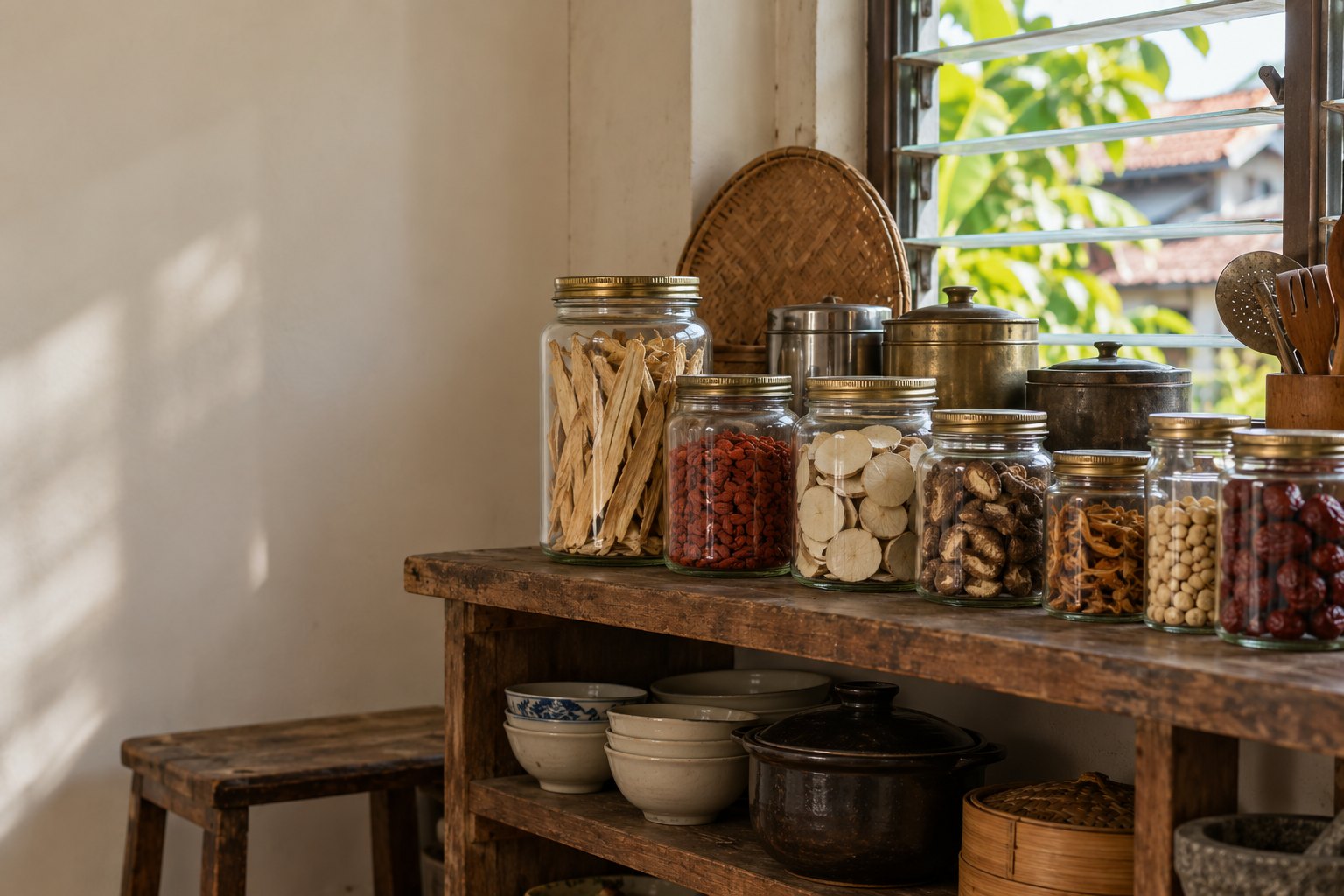
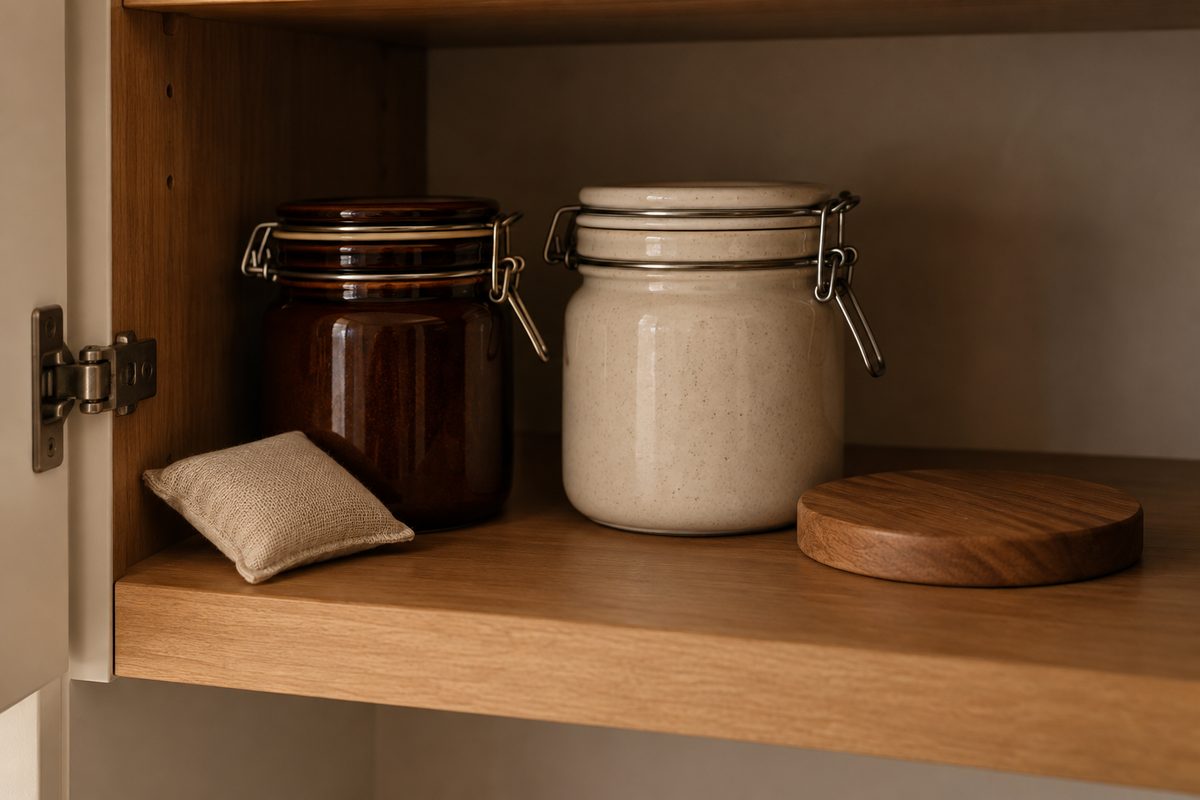
- Sealed, away from light and heat. Move an opened packet into a sealed jar or zip bag and keep it somewhere cool; not next to the stove, not in the car.
- Watch the moisture from air-conditioned rooms. Carried in and out of an air-conditioned room, packaging sweats on the outside, and moisture that reaches the herbs makes them damp. Keep it in one place; do not move it back and forth.
- Honey-fried and oily herbs go in the fridge. For example, anything labelled 蜜炙 or sticky to the touch. The oily-herb rule is our own practice; Hong Kong's guidance mentions honey-fried herbs only.
- Three discard signals: mould, insect damage, off-smell. Any one of them means the whole packet goes. Do not wash or sun-dry it and use it anyway.
- The same goes for 凉茶 ingredients. They are a combination of herbs, so the storage rules are the same. As for drinking it, TCM theory holds that 凉茶 is cooling in nature and is not for drinking daily in place of water; details in "Is Daily Herbal Tea Harmful?" (/is-daily-herbal-tea-harmful/).
Three common scenes, too:
- Packets weighed out at a medical hall, confinement (坐月子) packs: no MAL number is normal (part 3). Ask the shop what situation the packet was composed for, and store it by the five rules above.
- A cup from the 凉茶 shop, canned 凉茶: drink a fresh brew the same day; read the nutrition label on a can. Whether to drink it daily is in part 4.
- Air-conditioned rooms and cars: neither is a place to keep herbs. Keep them in one cool spot at home and carry only the day's portion.
⚠️ A safety note: there is no single number of days for "too long". Hong Kong's guidance is that herbs stored too long should not be used; if you cannot say when a packet was bought, treat it as too long.
The words in this part
All four are written into that article, and all four are things you may hear at a medical hall or read on a prescription.
- 陈皮 (橘皮, aged tangerine peel) — the article's words: 橘皮, also called 「陈皮」. It is the example the article uses for "time changes what is in a herb".
- Hesperidin (橙皮苷) — the article names it as the constituent chiefly responsible for 陈皮's effect; after a period of storage, as the volatile-oil content falls, its content rises in relative terms.
- Volatile aromatic oil (挥发性芳香油) — the article states that aromatic herbs generally contain volatile aromatic oils, which is why they should not be stored for long. The ones you can smell are usually in this group.
- Hydrolysis (水解) — the word the article uses to explain humidity: under a certain humidity and temperature, the enzyme causes hydrolysis of the glycoside constituents, lowering their content.
Frequently asked
How long can Chinese herbs be kept? There is no single number of days. Hong Kong's Chinese Medicine Regulatory Office says that in general herbs stored too long should not be used; aromatic herbs should not be stored for long; for example, honey-fried herbs should be refrigerated to prevent mould. For packaged proprietary medicine, go by the expiry date on the label. For loose herbs, watch for three signals: mould, insect damage, off-smell; any one of them means discard.
Can mouldy herbs be washed or sun-dried and still used? Our practice is no. The Hong Kong article lists damage by micro-organisms among the factors affecting quality, and says nothing about what washing or drying recovers — what it says is that such herbs should not be used. So this one is handled as "the whole packet goes", not as "treat it and carry on".
Do not: decide whether to keep a packet on the basis that it "still looks all right". The enzyme explanation in section I is precisely the case where the look and the constituents can disagree.
The other five parts
- Part 1: Do Chinese herbs carry risks? Which class has the record, and how Malaysia regulates it
- Part 2: The class with the record: what the record says, and why registration screening catches it
- Part 3: Can I take what I bought? Reading and checking the MAL number and Meditag
- Part 4: One table: what you are holding, and how to check it
- Part 6: Situations that need extra care — who asks a doctor and a practitioner first, and what to do if you feel unwell
👉 If you are unsure whether "this packet of herbs, or this bottle of proprietary medicine in my hand, is actually right for me to use", you are welcome to book an online consultation with HansMed, where a practitioner registered under the T&CM Act 2016 assesses it with you.
Sit with a licensed TCM practitioner from wherever you are.
HansMed Modern TCM
For general wellness education only — not medical advice. Consult a registered TCM practitioner for personal guidance.
Sources
- Chinese Medicine Regulatory Office, Department of Health, Hong Kong, feature article on general knowledge of taking Chinese medicines, dietary precautions and storage methods — https://www.cmro.gov.hk/files/gb/useful_information/public_health/feature_articles/Knowledge_of_Taking_Chinese_Medicines_Precautions_and_Storage_Method.pdf