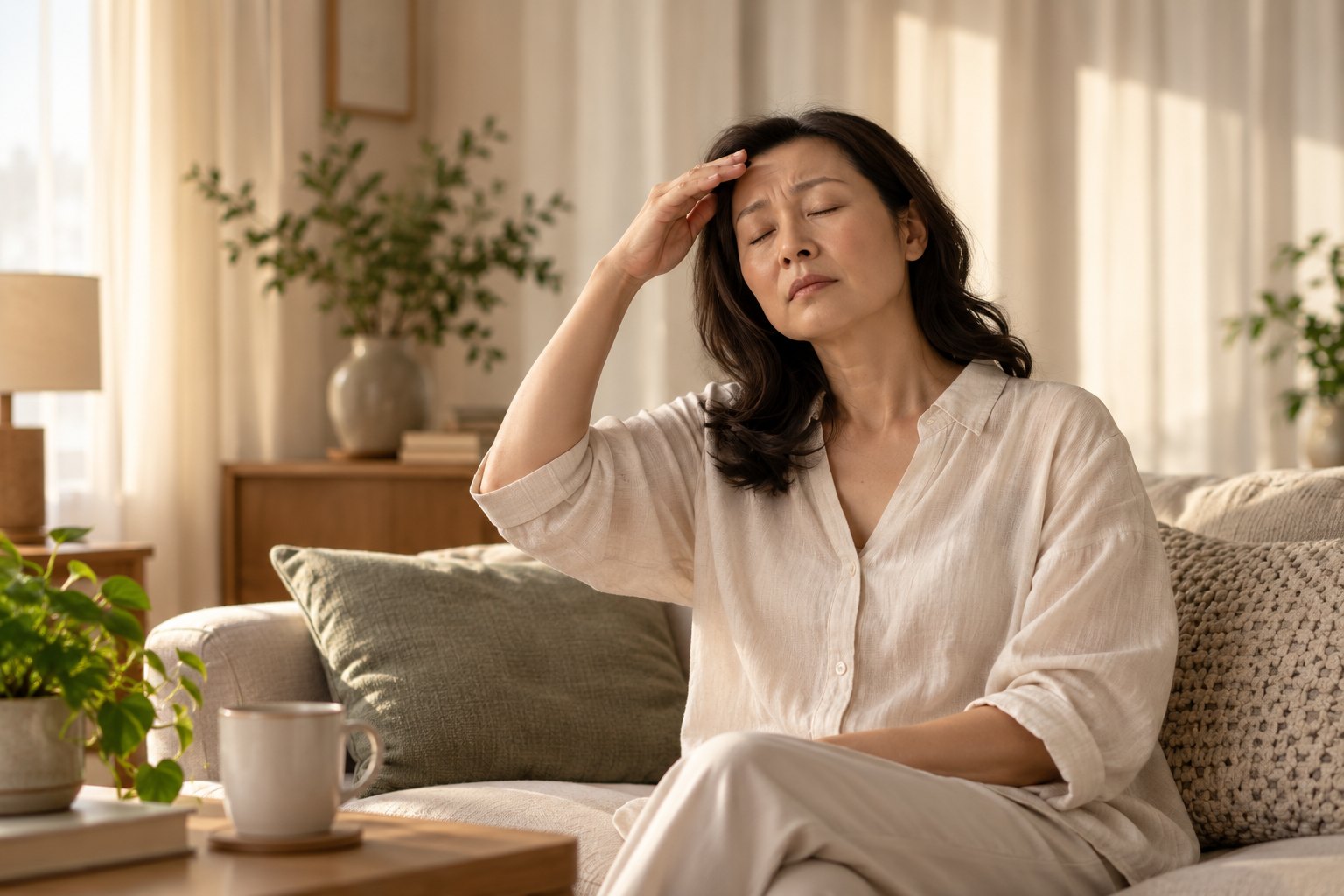
"The last six months I've just been off — hot flushes, poor sleep, shorter temper. Is this menopause?" It is a question that comes up often — asked with a slight hesitation, as though it might not count as a thing worth raising.
It does. This article is about how TCM views the changes of this stage, and the 5 things a practitioner asks about — and, just as importantly, when to see a gynaecologist first.
I. First: menopause is a life stage, not a disease
Worth establishing up front.
Menopause is a natural transition in a life stage, not an illness. Medically it is defined around the cessation of periods, and the transition around it varies in length from person to person. Whether you have entered that stage, and whether hormone-related treatment is appropriate, belongs to a gynaecologist's judgement.
The TCM view treats it as a period of transition in the body, and a consultation looks at the changes as part of the whole picture. How TCM understands that transition belongs to the theoretical framework of the organ systems and qi — a different kind of explanation from modern endocrinology. The two should not be conflated.
💡 Remember: "it's natural" does not mean "you just put up with it." A natural stage can still be discussed and cared for.
II. The 5 things a practitioner asks about
- Changes to the cycle — longer or shorter, changes in flow, when the last period was.
- Temperature-related changes — flushes, night sweats, changes in how hot or cold you run, which times of day are worst.
- Sleep — falling asleep, waking at night, getting back to sleep.
- Mood and energy — swings, concentration, how tired you are.
- Existing diagnoses and medication — your doctor's diagnosis, any hormone-related medication, bone density or lipid results, anything else you take.
That fifth matters especially. Blood pressure, lipids and bone density often start being tracked at this stage, and those belong to the medical side — follow your doctor's judgement.
💡 Remember: asking about mood and sleep is not attributing your difficulties to mood. The changes of this stage genuinely run across several areas at once.
III. How to describe it usefully
| Instead of | Say |
|---|---|
| "I think I'm menopausal" | "My last period was March last year; nothing since" |
| "I get hot a lot" | "Five or six times a day, worst at night, enough sweating to change clothes" |
| "I don't sleep well" | "I wake around three and can't get back to sleep" |
| "My temper is worse" | "Irritable easily, especially the day after a bad night" |
| "I take something" | "Hormone medication my doctor prescribed, for six months now" |
This table deliberately does not say what any answer means. TCM is not a self-assessment quiz — distinguishing is what a practitioner does after a consultation.
IV. See a gynaecologist or doctor first in these situations
- Any bleeding after menopause — always get this checked; this is the one that cannot wait
- Before menopause: bleeding between periods, after intercourse, or a sudden marked increase in flow
- A lump you can feel in the breast or abdomen
- Chest pain or palpitations with breathlessness or a cold sweat — call 999 now, or go to the nearest emergency department
- Persistently low mood, anxiety that is hard to control, or loss of interest in things — tell your doctor; this needs professional support
- Concerns about fracture risk, or a fracture from a minor fall
- Taking or considering hormone-related treatment — this belongs to your doctor's judgement; follow their advice and never stop or adjust it on your own
⚠️ A safety note: TCM and Western medicine complement each other; it is not a choice between them. The routine checks of this stage — blood pressure, lipids, bone density, breast and cervical screening — are not something a TCM consultation replaces. Follow your doctor's schedule for them.
A note: this section is general information only. For conditions like these, follow your doctor's diagnosis and treatment, and seek medical attention when you need it.
V. Fitting it into life in Malaysia
- Air-conditioning and flushes. Strong office air-conditioning against the heat outside makes for a large swing across the day — part of what gets asked.
- Track two weeks first. How many flushes a day, at what times, how often you wake at night. Far more accurate than recall.
- Routine test reports. Blood pressure, lipids, bone density, breast screening — mention any you have had.
- Supplements from family. Plenty gets recommended at this stage; say what you are actually taking.
- What else is happening at home. Caring for elderly parents, children's exams, work pressure — several things often stack at this stage, and it is worth saying so.
On preparing: what to prepare before an online consultation. On what the consultation covers: what TCM gynaecology covers.
In closing
✅ Worth remembering:
- Menopause is a life stage, not a disease — but "natural" does not mean "endure it".
- A practitioner asks about cycle changes, temperature-related changes, sleep, mood and energy, and existing diagnoses and medication.
- Hormone-related treatment belongs to your doctor's judgement — follow their advice.
- Any bleeding after menopause needs checking. That is the one that cannot wait.
- Blood pressure, lipids, bone density and screening are not replaced by a TCM consultation.
❌ Better not to:
- Treat bleeding after menopause as a sign of renewed youth and leave it uninvestigated.
- Stop hormone medication on your own because you have started TCM care.
- Write off persistent low mood as "everyone's like this at this age" — tell your doctor.
👉 If you would like to set the changes out for a practitioner, you are welcome to book an online consultation with HansMed, where a practitioner registered under the T&CM Act 2016 can assess it with you; if anything in section IV applies, see a doctor or a gynaecologist first.
Reviewed by Ms. Koo Shuang, a TCM practitioner registered with Malaysia's Traditional and Complementary Medicine Council under the T&CM Act 2016, practising in gastroenterology, dermatology, respiratory and women's health.
Sit with a licensed TCM practitioner from wherever you are.
HansMed Modern TCM
For general wellness education only — not medical advice. Consult a registered TCM practitioner for personal guidance.